Retailers planned to hire between 265,000 and 365,000 seasonal workers for the 2025 holiday season, the smallest seasonal hiring push in at least 15 years, according to the National Retail Federation. The year before, that number was 442,000. Meanwhile, US shoppers spent $257.8 billion online during the same holiday season, up 6.8% year over year, a record.
Fewer people are available to hire, and there’s more freight to move. That gap doesn’t close by itself, and it’s the reason retail and FMCG distribution centers are looking past temporary staffing toward automation that adds capacity without adding headcount.
In this piece:
- Why hiring and laying off a temp workforce every quarter costs more than the per-hire price tag suggests.
- Why a promotional surge is a different problem from ordinary peak volume, because it changes which SKUs need fast retrieval, not just how many orders there are.
- What a peak-season automation system has to do to solve both problems.
- Where Rapyuta ASRS fits, and where US buyers should still ask questions before committing to a timeline.
The challenge: peak season is squeezing retail and FMCG DCs
Seasonal hiring looks affordable on a per-person basis. A temporary warehouse hire runs roughly $800 to bring on. The real cost shows up after that, in churn. Warehouse turnover sits at 35% to 50% annually under normal conditions, and it accelerates once volume climbs. Each departure costs an estimated $18,600 once recruiting, training, and lost productivity are counted; and facilities that run short-handed during high-volume periods see overtime costs rise by roughly 47%.
Run that math across a two-month peak window and the appeal of hiring your way out of a promotional surge starts to look thinner than the per-hire number suggests.
There’s a second, less-discussed problem underneath the labor cost. A promotional surge does more than add volume: it reshuffles which SKUs move. A flyer item that sold three units a week in October can sell three hundred on the day the promotion runs. The warehouse has to reach that item at the same speed as its top sellers, not at the speed it’s normally stored for.
Some storage systems retrieve bins by stacking them on top of each other and digging down through the stack to reach whatever’s underneath. That works fine when the SKU someone orders is usually near the top. It stops working the moment a slow mover becomes the day’s best seller, which is exactly what a promotion does.
So a DC heading into peak season is really carrying two costs at once: the cost of staffing up and down every quarter, and the cost of a storage system that gets slower precisely when demand gets less predictable.
The need: what peak-season automation has to do
Given that problem, a system worth adopting ahead of a promotional calendar must clear a few bars, not just post a good throughput number on a spec sheet:
- Add capacity without adding a temp-hiring cycle. Capacity must scale up before a surge and hold steady, rather than requiring a new round of recruiting, training, and January layoffs every year.
- Keep retrieval speed independent of SKU velocity. If a promotion can turn a slow mover into a top seller overnight, the system can’t waste time reaching whatever’s suddenly in demand.
- Deploy on a Q4 timeline, not a construction timeline. Capacity that’s still mid-retrofit when the promotional calendar starts doesn’t help.
- Work with a workforce that’s partly new. Given the turnover numbers above, a meaningful share of any peak-season picking floor will be in its first few weeks on the job, so the system has to support accuracy without relying on tenure.
That’s the checklist. Here’s how it maps onto an actual deployment.
How a retail or FMCG DC can put Rapyuta ASRS to work
Ahead of a promotional calendar, in an existing building
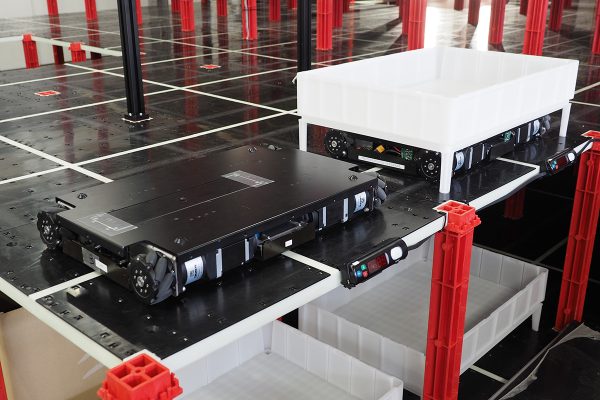
Rapyuta ASRS installs without floor anchoring or a reinforced slab; it sits on the existing floor. A DC doesn’t have to schedule a construction project before added capacity can go in, which matters when the deadline is a fixed date on the retail calendar rather than a flexible one.
In a leased fulfillment center
Because there’s no floor penetration, a system installed in a leased building can be relocated without leaving structural changes behind for the landlord to deal with. That’s a real consideration for retailers who lease peak-season overflow space rather than owning it outright.
As a phased build instead of a single big spend
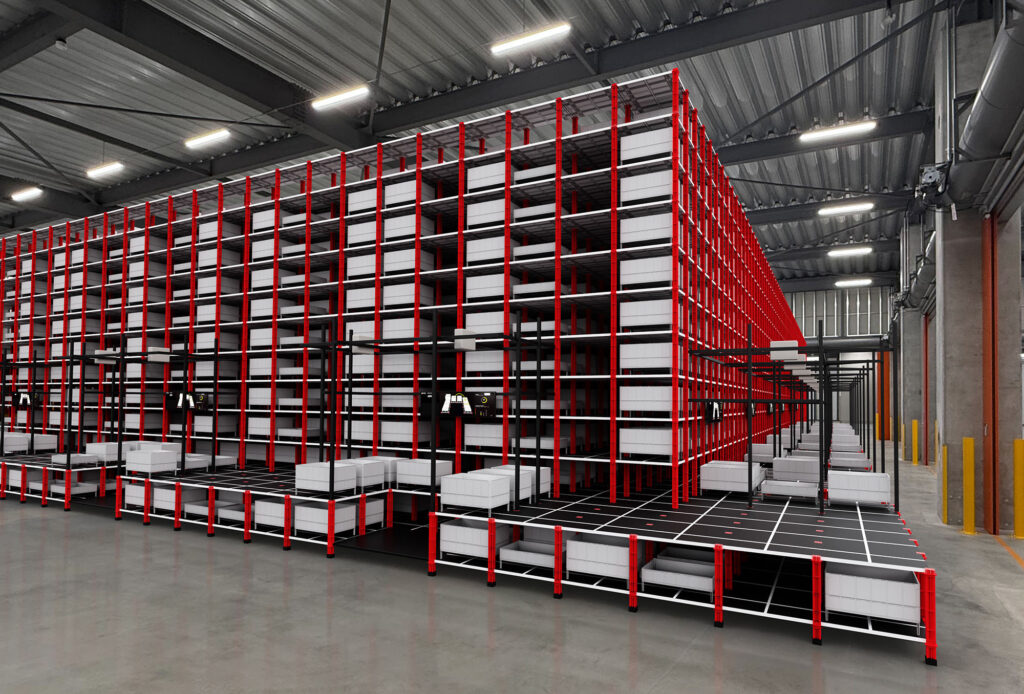
The structure expands modularly: robots, storage levels, or picking stations can be added without shutting the operation down. A DC can bring on a base configuration, then add stations ahead of a specific promotional event rather than sizing the whole system for a worst-case peak that only happens a few weeks a year.
On a promotion-heavy SKU mix
Retail and FMCG DCs running frequent flyer or doorbuster promotions are the clearest fit. Their operational pain point, a slow mover suddenly needing fast retrieval, is exactly what direct bin access is built to remove.
Alongside a workforce that turns over mid-season
Because the picking station is designed for accuracy without relying on an experienced operator (more on that below), a DC can bring on new seasonal hires through November and December without retraining the floor from scratch every time turnover hits.
How Rapyuta ASRS helps absorb the surge itself
Direct bin access, so retrieval speed doesn’t depend on what’s popular
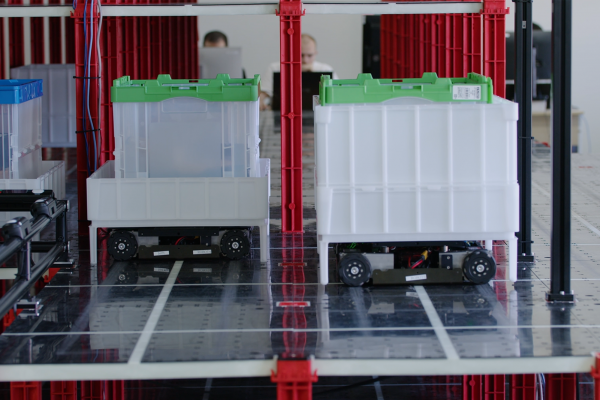
Rapyuta ASRS robots travel to a bin and lift it without moving anything stacked above or around it. A promotional surge changes which items are hot; it doesn’t change how fast the system reaches them, because nothing has to be dug out from underneath anything else.
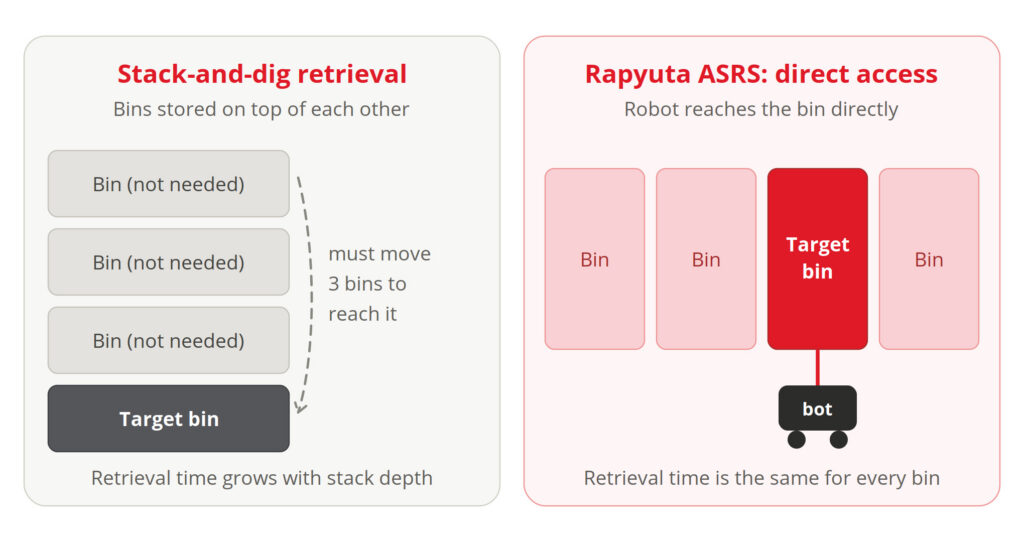
| Aspect | Stack-and-dig retrieval | Rapyuta ASRS direct access |
| Retrieval path | Digs through whatever’s stacked above the target bin | Travels straight to the target bin |
| Effect of a promotional surge | Slows down when a slow mover suddenly needs fast retrieval | Unaffected: retrieval speed doesn’t depend on sales history |
| What it penalizes | SKUs stored deep in the stack | Nothing: every bin is reached the same way |
Modular expansion instead of a temp-hiring cycle
Robots, storage levels, or picking stations can be added without a shutdown, so a DC can scale capacity ahead of a promotional calendar and hold that capacity as long as it’s needed, rather than rebuilding a temporary workforce from zero every season.
A fleet that keeps running without a staffing shadow
Battery changes happen automatically at a bank that holds up to 12 batteries, with robots driving themselves in to swap. Keeping the fleet powered through a surge doesn’t require a charging shift, forklift-style downtime waiting on a battery, or an added labor line.
No integration project standing between now and go-live
Rapyuta ASRS runs on its own warehouse management layer; a host WMS integration is optional, not required. That matters when the goal is to have capacity online before the season starts, not mid-way through an IT project.
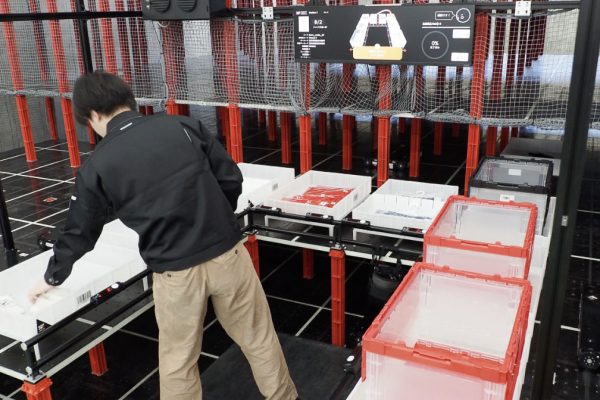
A picking station built for a first-week hire
A single station has a mechanical capability of 400 bins per hour, a figure that assumes four SKU bins arriving at the station and that moves with operator skill and the goods being handled. That qualifier is worth keeping in view given how much of the floor is new during peak.
The station itself is designed around that reality. A projector maps the exact bin location, a 3D sensor catches pick errors as they happen, and a monitor carries live work instructions, so accuracy doesn’t depend entirely on tenure. The station also serves eight bins in a C-shape, so the next bin is already arriving while the current one is being worked, and an associate isn’t standing idle between picks.
Getting ready before the season starts
If you’re weighing this for the season ahead, here’s the practical sequence:
- Get a site survey scheduled now. Floor flatness, ceiling height, dedicated circuit, and network line requirements all get confirmed at survey, not assumed from a spec sheet. Anchorless installation means no floor anchoring or reinforced slab, but site conditions still need sign-off before a timeline can be set.
- Ask for a lead time against your specific building and deadline. Don’t work backward from a headline number quoted for another market. Get the current US lead time in writing and check it against your peak-season start date, with buffer built in for install and training.
- Decide scope before committing to it. Because the structure expands modularly, you can start with a base configuration sized to steady-state volume and add stations or robots ahead of a known promotional event, rather than sizing the whole system for a worst case that only happens a few weeks a year.
- Flag WMS integration early, even though it’s optional. Running standalone removes a dependency, but if you want the system tied into an existing WMS, start that conversation well before peak so it isn’t a late-stage blocker.
- Loop in facilities if the site is leased. No floor penetration should mean no landlord sign-off for structural changes, but confirm that against your specific lease terms rather than assuming it.
- Start the conversation with enough runway. Rapyuta’s US operations run out of Schaumburg, Illinois, and that’s the team a site survey and timeline conversation would go through.
Are Storage Costs and Throughput
Limits Holding Back Your Warehouse?
FAQs
Does Rapyuta ASRS eliminate the need for seasonal warehouse staff entirely? No. Associates still run picking, stowing, and drop-off stations. What changes is how much throughput each associate supports, because the robots handle travel and retrieval instead of a person walking the floor, so the number of people needed to hit a given volume target drops and doesn’t need to scale linearly with order volume during a surge.
How is a promotional surge different from normal peak-season volume? Normal peak season means more of the same order pattern. A promotional surge changes which SKUs are in demand, often overnight, which penalizes storage systems that retrieve by digging through a stack of bins to reach whatever’s underneath. Direct bin access removes that penalty, because retrieval speed doesn’t depend on how often an item usually sells.
How long does it take to install Rapyuta ASRS before peak season? It depends on scope, and current US lead times should be confirmed directly rather than assumed from other markets. Anchorless installation removes one common delay, since there’s no floor anchoring, reinforced slab, or construction phase to schedule around.
How should I compare ASRS throughput numbers across vendors? Check the unit first. Bins per hour, lines per hour, and units per hour measure different things, and a side-by-side table that doesn’t specify the unit is not a fair comparison. Ask what’s being counted before comparing the number.