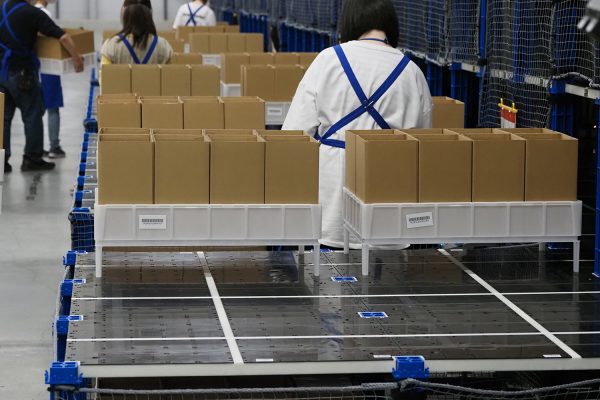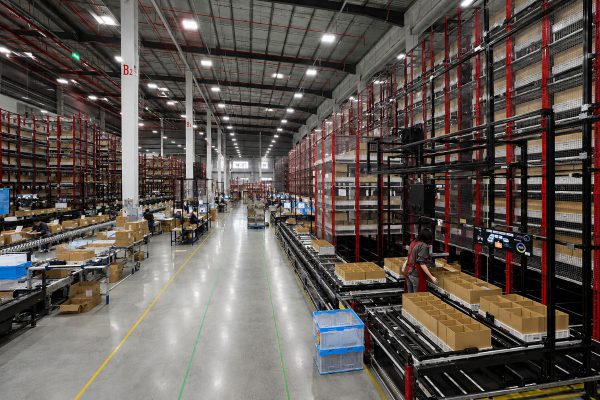
Robotic automated storage and retrieval systems went from a niche category to a crowded one in roughly five years. Cube storage, climbing robots, tote-handling AMRs, shuttle hybrids. Most vendors will tell you their approach is the right one, and the spec sheets are hard to line up because no two of them measure the same thing.
This guide sorts robotic ASRS into five types based on one variable: how the robot travels through the storage structure. That single question drives most of what matters downstream. Storage density. Where the throughput ceiling sits. How the system scales. What happens when something fails. Whether it fits a building you already occupy.
Each type gets a diagram, a read on what it does well, and the questions worth asking before a vendor gets to a proposal.
Where robotic ASRS sits in the broader category
Quick orientation before the detail.
An automated storage and retrieval system (ASRS) is computer-controlled equipment that stores inventory and delivers it to an operator on demand. Instead of a picker walking to the product, the product comes to a station. The industry calls this goods-to-person.
The category splits three ways by load type:
- Unit-load ASRS handles full pallets, usually with stacker cranes in high-bay racking. Common in manufacturing, food and beverage, and wholesale distribution.
- Mini-load ASRS handles totes, bins, cartons, and trays. This is the e-commerce, apparel, pharma, spare parts, and 3PL category.
- Special-purpose ASRS is engineered around one difficult load. Paper rolls, wafer carriers, sheet metal, automotive body panels.
Robotic systems live almost entirely inside mini-load. They replace the fixed crane or fixed-aisle shuttle with a fleet of mobile robots, which changes how the system scales and removes the aisle-level single point of failure that crane systems carry.
Everything below is about that robotic branch.
The five types at a glance
| Type | Robot travel | Storage density | How it scales | Retrofit fit |
| Grid-top travel | Horizontal on the top plane only; hoists bins up to itself | High | Add robots & ports for throughput. Storage grows by extending the grid, and part of it stays empty as retrieval buffer. | Good; configures around obstructions |
| Column-descending travel | Horizontal on the top plane, then descends into the structure at designated columns | High | Add robots for throughput. Access columns have to stay clear, so density and direct access trade against each other. | Moderate; wants significant clear height |
| Aisle-and-face travel | Floor horizontal, climbs the rack face, returns to floor to change aisle | High | Add robots for throughput. Added storage means more anchored guideway racking, so it is a construction project. | Moderate; anchoring makes the installation permanent |
| Level-bound travel | Horizontal on one level only; totes transfer by lift or crane | Medium to high | Add robots per level for horizontal capacity. The lift or crane caps the system and has to be added separately. | Moderate; depends on lift or crane installation requirements |
| Lift-carried travel | Horizontal under own power on any level; rides a lift with the tote | High | Strongest of the five. Robots and storage scale independently, and modules are added without rebuilding what is already there. | Strongest; always anchorless, so equally suited to brownfield and greenfield |
1. Grid-top travel
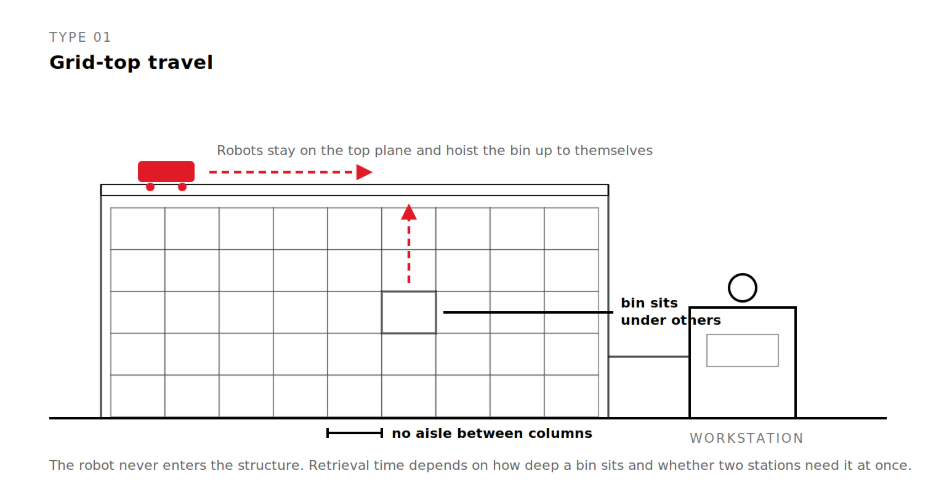
The robot stays on the top plane and hoists the bin up to itself.
Bins stack directly on one another inside an aluminum grid. No aisles. Robots move horizontally across the top plane and hoist bins up to themselves. The robot never enters the structure.
What it does well
- Densest of the five. The strongest answer when square footage is the binding constraint, which is why it dominates urban and micro-fulfillment projects.
- Slotting is automatic. Bins return to the top layer after use and slow movers sink over time, so no manual slotting effort is required.
- Modular. Robots and ports are individually serviceable, and capacity scales by adding units rather than re-engineering the structure.
What to understand before you compare
- The grid is not filled solid. Empty cells and open top-layer slots are working space, because a robot reaching a buried bin has to park the ones above it somewhere. Nominal grid capacity and usable storage capacity are different numbers.
- Because the robot works from above, reaching a lower bin means moving the bins on top of it first. Retrieval time therefore depends on depth, and published depth and retrieval figures assume demand is concentrated in a small share of SKUs. That assumption holds for most e-commerce catalogs.
- It holds less well if your demand curve is flat, or if the fast-moving share rotates with season and promotion. More picks then come from deeper in the stack.
- Contention: when two workstations need the same bin, one waits.
- Net effect: here, inventory placement decides whether a bin can be reached quickly at all, not just how far a robot travels to get it.
Ask about
- How concentrated your demand curve actually is, and what retrieval times look like if it flattens
- How much of the nominal grid gets consumed as digging buffer
- Contention at your real order profile
- What happens at a peak well above your average day
- Recovery when a robot stalls on the deck rather than at a service point, since it is then sitting on top of the cells underneath it
Named occupants: AutoStore and Ocado. AutoStore reaches the US market through partners including Kardex, Swisslog, Element Logic, and Toyota Automated Logistics.
2. Column-descending travel
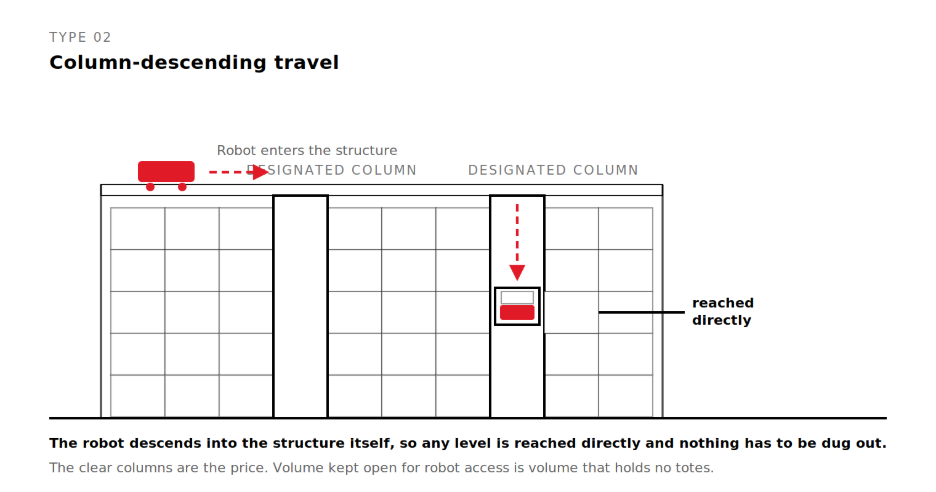
Robots move horizontally across the top plane like grid-top systems, but instead of hoisting from above they descend into the structure through designated clear columns and reach a tote at whatever level it sits on.
What it does well
- No digging. Because the robot goes in and comes to the tote, any level is reached directly and nothing above the target has to be moved out of the way first.
- Retrieval time does not depend on how concentrated your demand curve is, which removes the slotting exposure that grid-top systems carry.
- Suits very tall structures. Vertical travel inside the frame is what these systems are built around, so buildings with substantial clear height get used properly.
- Throughput scales by fleet. Robots can be added or removed as requirements change without touching the structure.
What to understand before you compare
- The access columns are the price of direct access. Volume kept clear so robots can enter and travel is volume that holds no totes, so a like-for-like density comparison against a solid grid has to account for it.
- Column count and placement are throughput variables. Too few and robots queue for entry, too many and you give away storage. That balance is a design decision to interrogate, not a given.
- The robot operates inside the structure, so a stall is inside the structure too and can block a column until it is recovered. That is a different recovery problem from a unit that fails on an open deck or at a service point.
- Fewer suppliers and fewer installed sites than the older architectures, so reference checking carries more weight.
Ask about
- How much storage volume the access columns consume, expressed against total structure volume
- How column count was chosen for your throughput, and what happens at peak if it was sized to average
- Recovery when a robot stalls inside the structure: how long, who performs it, and what is inaccessible meanwhile
- Reference sites at your volume and SKU count, running rather than commissioning
- Building requirements: clear height, floor flatness, seismic, and fire suppression given the enclosed structure
Named occupants: Urbx and Attabotics.
3. Aisle-and-face travel
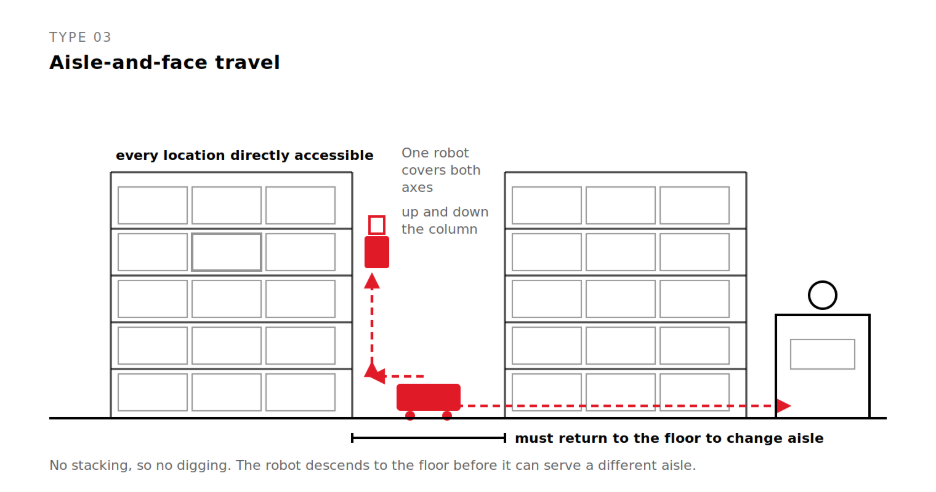
The robot drives horizontally along the aisle floor, climbs the rack face to reach a tote, and comes back down to the floor before it can serve a different aisle. One robot covers both axes within its aisle.
What it does well
- Direct access to every location. Nothing stacks, so there is no digging and no retrieval penalty on slow movers. Cycle times stay consistent whatever your demand curve does.
- Throughput scales cleanly. Add robots, output rises. No structural work, no downtime.
- Strong fit where sequencing matters, or where the SKU mix moves around too fast for velocity-based placement to keep up.
- Some variants retrofit onto conventional racking, which lowers the barrier to a first installation.
What to understand before you compare
- Changing aisle means descending to the floor and driving around. Robots are effectively committed to an aisle for the duration of a task, so aisle count, aisle length, and how orders are distributed across aisles all feed into real throughput.
- Throughput and storage scale on different cost curves, and the spec sheet usually shows only the easy one. Robots are a line-item purchase. Storage capacity is not.
- More storage means more racking, and this racking is part of the robot guideway. It carries tighter structural and tolerance requirements than plain shelving and is typically anchored to the floor. Expanding it is a construction project: fixed cost, install schedule, likely permitting, possibly a fire-suppression review, and disruption to whatever area is being worked on.
- Cycle time is sensitive to layout. A long, shallow footprint keeps robots travelling further than a compact one, and that never appears on a spec sheet.
- Container formats are usually fixed to a standard footprint in a small number of heights.
Ask about
- Throughput modeled on your aisle layout and your order distribution across aisles, not a reference footprint
- What a storage expansion actually involves: cost, lead time, permitting, anchoring, and how much of the operation stops while it happens
- Whether the racking can be relocated later, or whether anchoring makes the installation permanent
- The availability commitment in full, rather than the headline figure
- Whether your products fit the standard container heights
Named occupants: Exotec, HAI Robotics, and BionicHIVE.
4. Level-bound travel
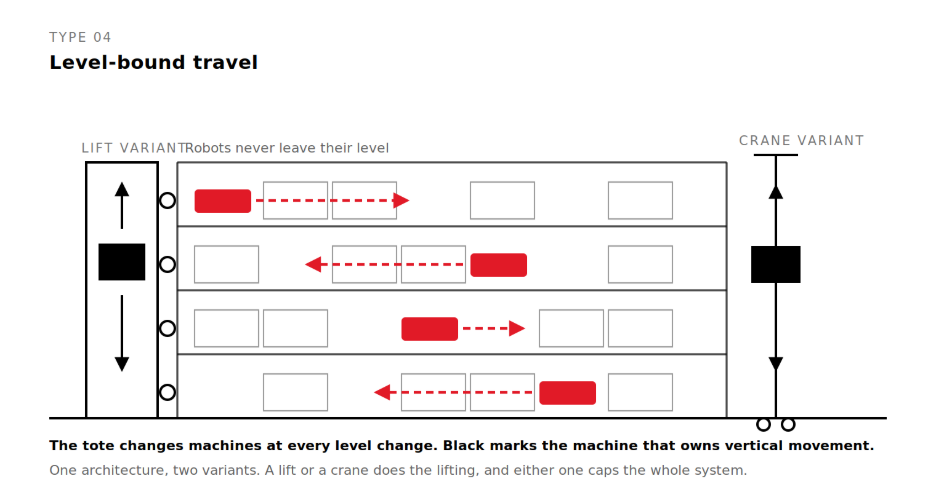
Robots move horizontally on one level and never leave it. Totes change level by a separate machine, either a lift or a crane depending on the variant. Both variants share the same logic, so they are one architecture rather than two.
What it does well
- Predictable to model. Horizontal and vertical capacity are sized separately, so throughput is easier to reason about on paper than where one robot does everything.
- Direct access to every location on a level. No stacking, no digging.
- Familiar engineering with a mature service base, since conventional tote shuttles have been installed for decades.
- In the crane variant, proven lifting capability for heavier loads and taller structures, and a maintenance model that companies with crane experience already understand.
What to understand before you compare
- Every level change is a handoff. The tote leaves one machine and is collected by another, so the transfer point is both a throughput constraint and a place where stalls and errors happen.
- The lift or crane sets the ceiling. Once vertical capacity saturates in your peak hour, adding robots on the levels buys nothing. Size it against your busiest sixty minutes, not your daily average.
- Any architecture with vertical transport shares this constraint, including lift-carried systems. What differs is how easily you add capacity. In some designs a lift is an incremental addition. In others it is integrated into the rack structure, which makes adding one a construction project.
- An outage in the lift or crane can take a whole vertical zone with it, which reconcentrates the failure risk that fleet-based systems are meant to spread. The crane variant concentrates it further, since one crane usually serves more of the structure than one lift.
- In the crane variant, two suppliers of control logic often means two owners of the integration between crane software and fleet management. Split responsibility there is a common source of trouble after launch.
Ask about
- Throughput at your peak hour, modeled on your order history rather than a design average
- What adding vertical capacity involves: cost, install time, commissioning, and how much of the system stops during the work
- Degraded-mode throughput with one lift or the crane offline, and how many levels it affects
- Error rates at the transfer point and what recovery requires
- Who owns the control integration, and who you call when the fault sits between the two systems
Named occupants: Conventional tote shuttle systems from Dematic, Vanderlande, Knapp, and TGW, mobile-robot variants such as Libiao Robotics (AirRob), and the crane-assisted variant from ROMS (Nano-Stream).
5. Lift-carried travel
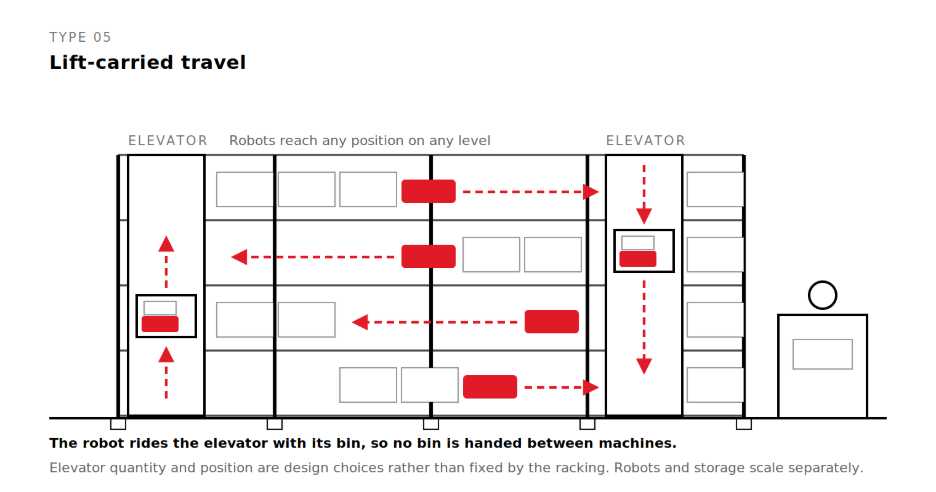
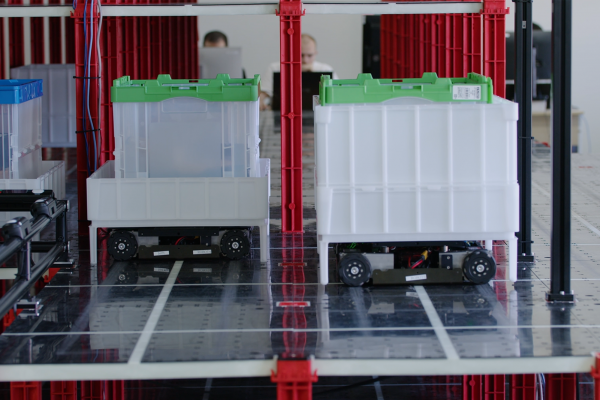
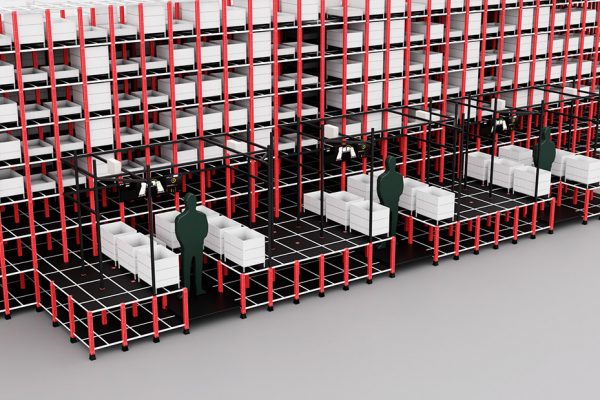
Robots travel horizontally under their own power on any level and ride high-speed lifts between levels, carrying the tote with them. There is no fixed aisle assignment, and no point where a tote is handed from one machine to another.
What it does well
- Robots and storage scale separately. Throughput comes from adding robots, capacity from adding structure, so you buy the one you actually need.
- No handoff. The robot boards the lift with its tote and stays with it to the picking station, which removes a class of transfer-point stalls and errors that level-bound architectures have to design around.
- Direct access to every location on every level, so retrieval times do not depend on how concentrated your demand curve is.
- Always anchorless. The structure is never fixed to the floor, so it can be assembled inside an occupied building, configured around columns and beams, extended in phases, and relocated if the site changes. That makes it equally suited to a new building and to one you already run, and it moves mezzanines, uneven ceiling heights, and awkward floor plates out of the disqualifying column.
What to understand before you compare
- Vertical capacity is a constraint here as in any architecture that moves loads between levels. What differs is the cost of relieving it. Lift quantity and placement are specified to the throughput you need, and because the structure is modular they are sited where the layout allows rather than where the racking dictates. Size them against your peak hour regardless. The difference is that doing so later is an addition rather than a rebuild.
- The distinction from level-bound systems is worth stating plainly, because both use lifts. There, the robot stays on its level and the tote is handed to the lift and collected by a different robot. Here, the robot rides with the tote and delivers it itself.
- Slotting still matters, and the system does position totes by shipping frequency. What changes is what slotting buys you: with every location directly accessible, velocity placement shortens robot travel rather than deciding whether a tote can be reached quickly at all.
- Performance rests on multi-robot coordination, which is a software problem more than a hardware one. That is where the evaluation effort belongs.
- This is the newest of the five approaches, and newness is a legitimate reason for caution.
Ask about
- Reference sites running at volume rather than pilots
- What adding a lift to a live installation involves: cost, commissioning, and how much of the system stops
- Degraded-mode throughput with one lift or a group of robots offline
- An honest account of what the first few months after go-live looked like for existing customers
Named occupant: Rapyuta Robotics (Rapyuta ASRS), with a US demonstration facility in Schaumburg, Illinois.
What drives the cost of a robotic ASRS
Pricing in this category varies so widely that published figures are close to useless for planning. Two systems storing the same inventory can differ by a large multiple depending on throughput requirements and how much work the building needs. What is worth understanding is the structure of the cost, because it tells you which decisions are expensive to change later.
- Dynamic components versus static components. Robots, lifts, cranes, and workstations are usually the expensive part, and storage structure the cheaper part. That is why cost per cubic foot falls as systems get larger. But the ratio varies more by architecture than vendors tend to volunteer. Where robots climb the racking, the racking is part of the guideway and carries structural requirements that make added storage a construction project rather than a purchase. Ask for the cost of the next increment of throughput and the next increment of storage separately, because in some architectures they are nothing alike.
- Software and integration. WMS or ERP integration, custom workflow development, and warehouse execution software get underestimated more often than anything else on the list. Ask who owns the interface and what happens when your WMS gets upgraded.
- Facility work. Floor flatness and leveling, power capacity, and fire suppression. Denser storage frequently triggers a fire code review, and that surprises people late in the process. Insurance terms can shift as well, since you are concentrating far more inventory value into less space.
- Environment. Cold storage, cleanroom, and seismic requirements all add cost, and they narrow the vendor field before price ever comes up.
- Ongoing costs. Service contracts, software licensing, spare parts, and the internal headcount to keep the system running. A cheaper system with a thin support model can cost more over five years.
Get a simulation run against your real order history before you compare proposals. Any credible vendor will do this, and the output is far more informative than a price alone.
Evaluate from the C-suite and from the floor
An ASRS is not a labor-reduction purchase. It sets the throughput ceiling of a distribution center and shapes what the business can commit to for years.
- From the executive side, the question is whether the investment raises that ceiling. More orders out the door per day. More inventory in the same building. Lower cost per unit shipped. Higher output from a smaller and more stable team. Consistent service levels that protect customer relationships during peak instead of putting them at risk. Those outcomes show up in revenue capacity, not just in a labor line.
- From the floor side, the question is whether people can run it. Shorter travel. Manageable pick and replenishment workload. Sensible exception handling when a tote is short or a carton is damaged. Predictable behavior in the weeks when volume triples. A system that requires perfect conditions will find plenty of imperfect ones.
Both have to be true. Compare specifications alone and the familiar problems follow. Output lands under projection. Exception handling eats the labor savings. WMS integration takes two quarters longer than planned.
Choosing the right robotic ASRS for your operation
Robotic ASRS is not one thing. How the robot travels determines density, where the throughput ceiling sits, how the system scales, how it fails, and whether it can go into a building you already occupy. Those differences are large enough to change which system belongs in your facility.
Products that look similar on a comparison chart differ in design intent and in how they hold up against a real order mix. The decision comes down to your load types, SKU count, order profile, peak volume swing, building constraints, and growth outlook.
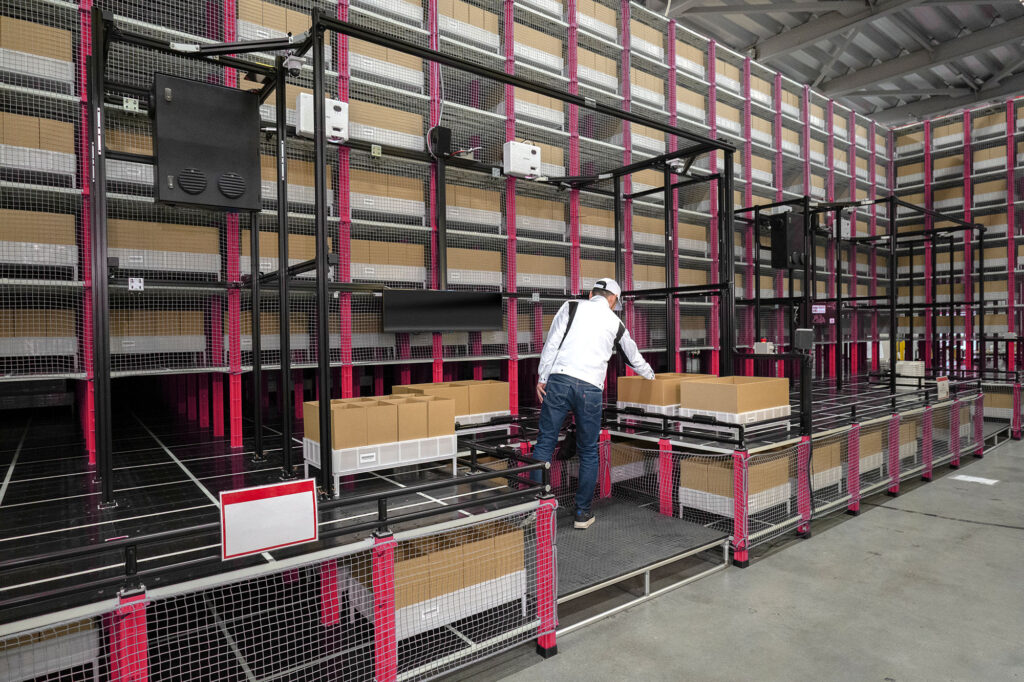
Want to see a system running?
Our Schaumburg, Illinois demo facility is a short drive from O’Hare.
This article compares system architectures rather than specific product performance. Capability varies by configuration and site conditions. Confirm all specifications with the relevant manufacturer.
Frequently asked questions
What is the difference between ASRS and AS/RS? Nothing. Both refer to automated storage and retrieval systems. AS/RS is the older convention and still common in engineering documentation. ASRS is more common in web search and marketing.
Which type has the highest throughput? None of them, categorically. Throughput depends on fleet size, workstation count and type, travel distances, and your order profile, and all five types can be configured across a wide range. The more useful question is where each type hits a ceiling. In grid-top systems it is retrieval depth and bin contention. In column-descending systems it is the number of access columns. In aisle-and-face systems it is travel distance and the trip back to the floor to change aisle. In level-bound systems it is the lift or the crane. In lift-carried systems it is fleet size and lift capacity.
Can a robotic ASRS go into an existing warehouse? Yes, and this is now a large share of deployments. Modular systems can be configured around columns, installed in phases while the site keeps running, and in some cases relocated later. Clear height, floor flatness, power availability, and fire suppression are the main site conditions to verify early.
What happens when a robot breaks down? In fleet-based systems the remaining robots pick up the work, so throughput usually dips rather than stopping. How gracefully that happens depends on where the robot fails. One that stops at a service point is straightforward. One that stalls inside the storage structure can block access to the locations around it until it is recovered. Ask each vendor what recovery looks like in that case, how long it takes, and who performs it.
How do I choose between them? Start with your constraint rather than the technology. If it is floor space, look at grid-top travel first. If it is unpredictable retrieval times, look at direct-access architectures. If it is a building you cannot modify, look at modular systems designed for retrofit. Then run a simulation against your real order history and let the results narrow the field.