Most distribution centers already run a WMS. Most of them still cycle count every week. The distance between those two facts is what warehouse digital transformation actually has to close, and no amount of new software closes it by itself.
The reason is simple. Your WMS knows what people told it, at the moments they chose to tell it. Everything between those moments is an estimate. This article covers what a bin-level inventory record contains, what your current drift is costing you, how an automated storage and retrieval system produces the record as a side effect of moving goods, and where the honest limits sit.
What is a live bin-level inventory record?
A live bin-level inventory record tracks every storage container as an individual object with a known position, known contents, and a timestamped history of every move. Instead of knowing that a SKU sits somewhere in an aisle, you know which bin holds it, which slot inside that bin, and when it last moved.
In a Rapyuta ASRS installation, bins come in two configurations:
| Bin | Build | Use |
| Tall Bin | Bin base + cardboard wall | Bulkier items, deeper stock holding per bin |
| Short Bin | Bin base + cardboard wall | Small parts and lower-cube items |
Each bin holds up to 66 lb (30 kg) at 70% fill, and subdivides into as many as 36 slots using horizontal partitions in a 6×6 pattern. Recommended patterns are 1, 2, 3, 4, 6, or 9 divisions.
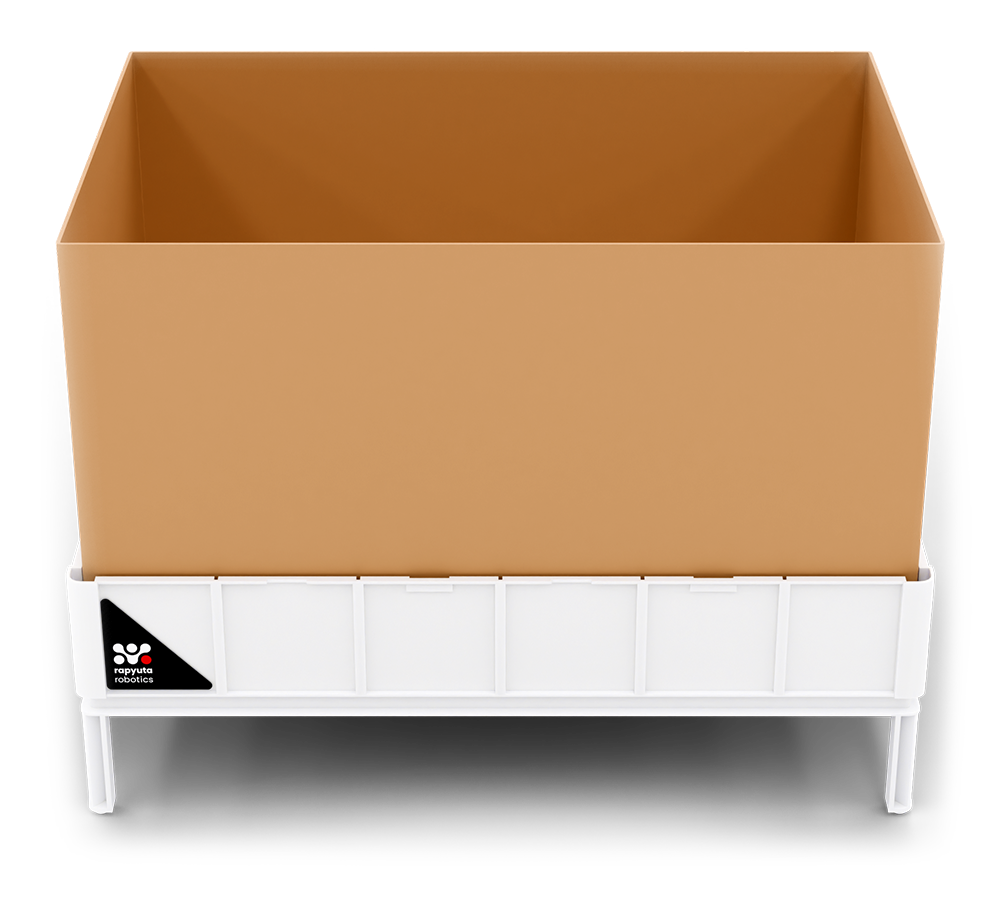
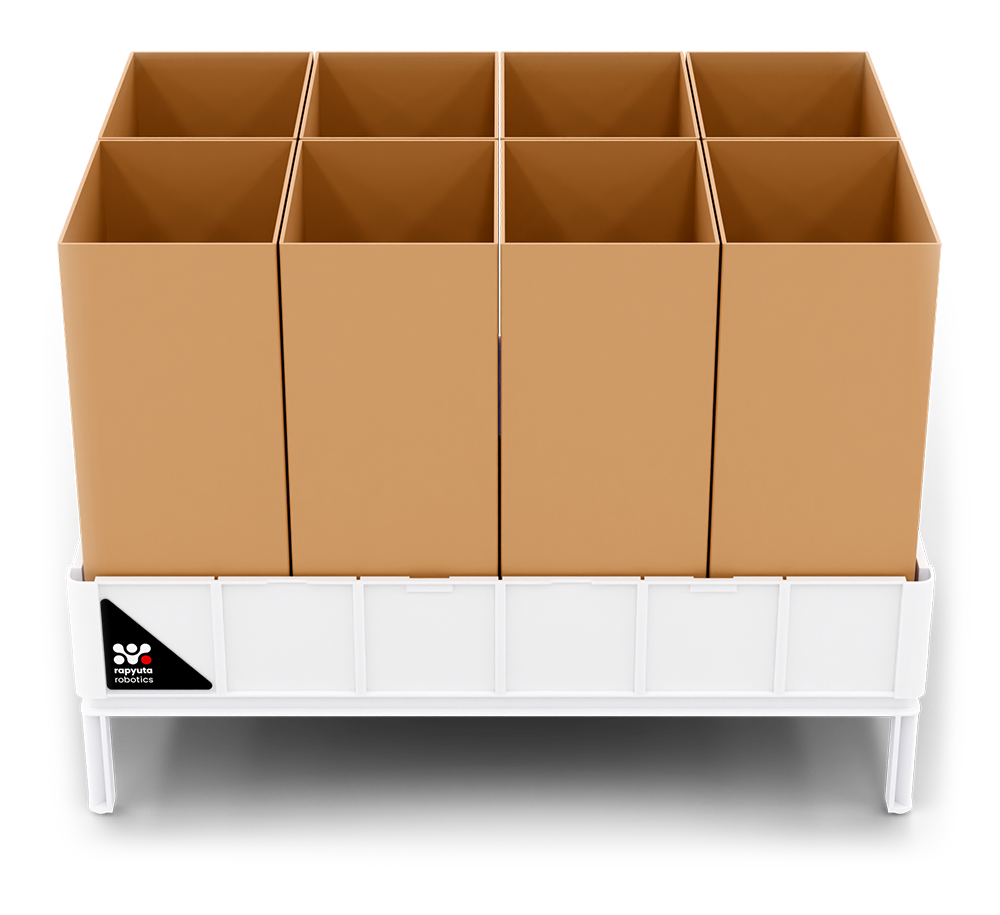
Already standardized on a tote? Third-party containers sit on the bin base as long as external dimensions stay within 16.76 × 25 in (425 × 635mm) and 18.11 in of height, or 14.17 in with shortened poles.
Five signs your inventory record is already drifting
Worth checking against your own operation before reading further:
- Cycle counting runs on a schedule rather than in response to a flagged exception.
- Pickers regularly find stock in a location the system did not point them to.
- Safety stock levels were set by someone who did not trust the on-hand number.
- Short picks get resolved on the floor and corrected in the system later, if at all.
- Year-end shrink includes a category everyone privately calls “it’s in here somewhere.”
Three or more of these, and your record is describing the last time somebody had a spare minute to update it, not the building as it stands right now.
Why scan-based records drift
Three properties of manual data capture explain nearly all of it.
Capture happens at the edges. Pallets get scanned inbound. Cartons get scanned outbound. The gap between can run weeks, and position inside that gap is inferred.
Capture is optional. A scan competes with a pick rate. A picker who takes the right SKU from the wrong slot ships a clean order and leaves behind a wrong record. A tote staged on the floor during peak does not get scanned back. A partial case gets merged into a neighboring location because it fits. This is not negligence. It is what happens when the person is measured on throughput and the data entry is on the honor system.
The move and the record are two separate acts. Somebody moves the goods, then somebody tells the system. Those are separated in time and performed under pressure, which is all the room a discrepancy needs.
What drift actually costs you
This is the part worth taking to a CFO, and it is worth pricing from your own books rather than from a vendor’s percentage. Four lines:
Counting labor. Counters, hours per cycle, loaded hourly rate, cycles per year. Most operations have never added this up as a single annual number, and it is usually larger than expected.
Safety stock held against distrust. Some portion of your buffer exists because the on-hand figure has been wrong before. Multiply those units by your carrying cost. That is inventory funded by a data problem.
Recovery work on short picks. Incidence rate, touches per recovery, and the expedite or split shipment at the end of it. Include the customer service time.
Shrink that was never actually lost. Written-off stock that sat misplaced in the building. This line is the hardest to size and often the largest.
Run those four against your own numbers before evaluating any system. They set the size of the prize, and they tell you whether this is a $50,000 problem or a $2 million one.
How ASRS creates the record instead of asking for it
Here is the mechanism, and it comes down to bounding the number of places where inventory can change without the system knowing.
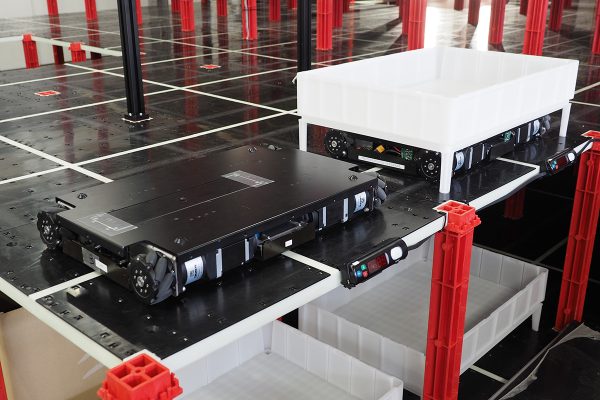
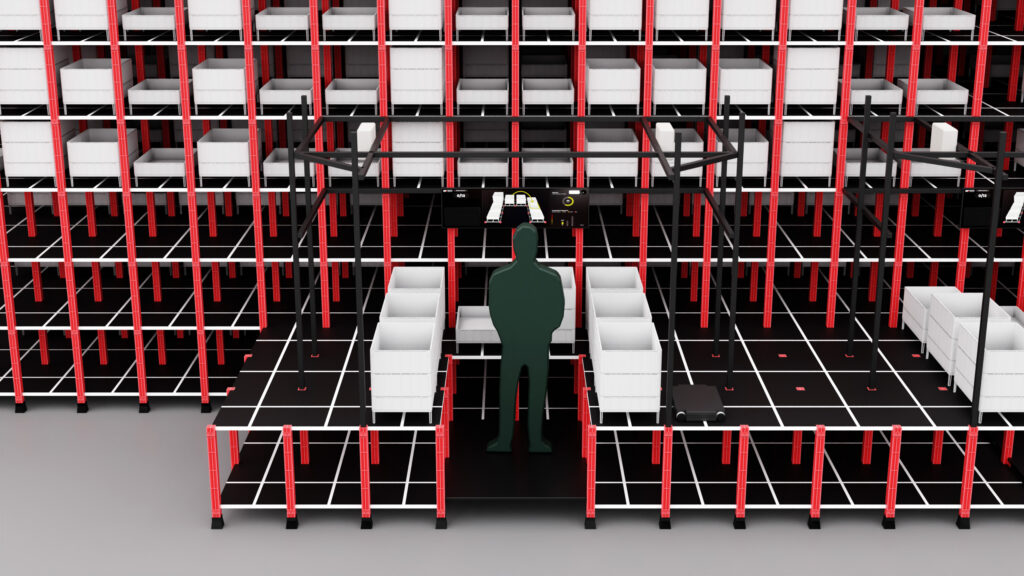
A bin cannot move unless a robot moves it, and robots are dispatched by the system. The robot drives underneath the bin and raises it by about 20mm, roughly 0.8 in, which is just enough to lift the bin clear of the frame it rests on. It then carries the bin at up to 6.27 mph (2.8 m/s), travelling in four directions without turning to change heading. While in storage, the bin never leaves the structure’s coordinate frame. Position is not reported by anyone. It is known.
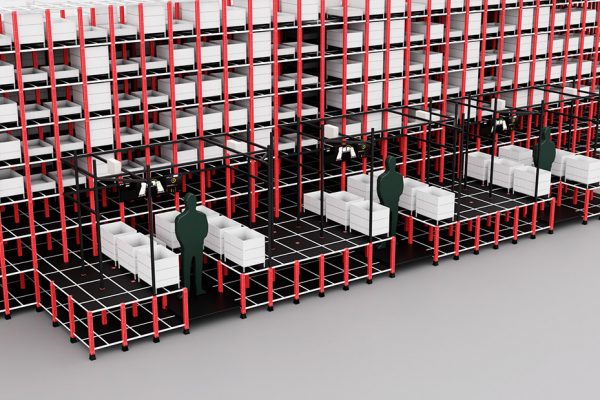
Contents change in exactly three places: a stowing station, a picking station, and a drop-off station. All three carry instrumentation:
- A projector marks the target bin with light from above, so the operator is directed to the slot rather than reading a location off a screen.
- A monitor carries work instructions and live productivity.
- A bin button confirms completion.
- A barcode scan validates the item at the moment it is handled, and carries the attribute checks that go with it: correct item, and lot or expiry where the product calls for it.
Operators still confirm their work. The difference is that the confirmation is verified by sensor at the moment of the pick, rather than being an unchecked self-report entered afterward. Errors get caught before they enter the record instead of being discovered in an audit six weeks later.
That is the whole argument for bin tracking system automation over another barcode discipline initiative. One approach removes the opportunity for the record to be wrong. The other asks people to try harder.

“Rapyuta ASRS had the best balance of processing capacity and storage density, and it fit perfectly with our inventory volumes and inbound/outbound requirements. And the flexibility of their software that allows us to operate the ASRS on our own WMS is another decisive factor.”
– Masanori Nodono, General Manager – Storage Unit
What the ASRS hands your bulk WMS
Rapyuta ASRS runs standalone with its own WMS layer, so host integration is optional rather than a project dependency. Most operations still want both: the ASRS governing what happens inside the structure, the enterprise or bulk WMS governing everything outside it.
Integration is REST API over HTTPS with CSV or JSON payloads. Twelve interfaces are exposed. Read them as the life of a bin rather than as a feature list.
| Interface group | Direction | Stage | What it settles |
| Product master | Host → ASRS | Setup | SKU identity, dimensions, handling |
| Image links | Host → ASRS | Setup | Item images shown at the station |
| Receiving plan | Host → ASRS | Inbound | What is expected, in what quantity |
| Receiving results | ASRS → Host | Inbound | What was actually accepted |
| Storage results | ASRS → Host | Putaway | Which bin and slot now holds the stock |
| Shipping instructions | Host → ASRS | Outbound | Order lines to be picked |
| Picking results | ASRS → Host | Outbound | Line-level confirmation of the pick |
| Drop-off results | ASRS → Host | Outbound | Consolidation and handoff complete |
| Inventory transfer | Both | Correction | Deliberate movement between locations |
| Inventory adjustment | Both | Correction | Reconciled variance, with reason code |
| Inventory list | ASRS → Host | Reconciliation | Full current position, on demand |
Plans and instructions flow in. Results and position flow out. Your bulk WMS stops guessing at what happened inside the automated footprint.
One design decision to make deliberately: use both the event-level messages and the periodic inventory list. The events give you accuracy within the shift. The list gives you a full snapshot to reconcile against. Take only the events and you have no way to notice a dropped message. Take only the list and you have rebuilt batch reporting with extra steps.
Does bin access method matter for data, or only for speed?
It matters for both, and the data half rarely comes up in evaluations.
In a system that stacks bins and digs down to reach the one it wants, retrieving a buried bin means relocating everything above it. Each of those relocations is a genuine state change that has to be tracked and reconciled, even though none of it corresponds to work anybody ordered. Pulling one slow-moving SKU can generate a small burst of housekeeping events.
Rapyuta ASRS uses direct bin access, with no digging and no shuffling. One retrieval is one bin event. Deep storage is reached by coordinating multiple robots rather than by unstacking, so depth does not inflate the count either.
For the floor, this means retrieval time stops depending on how fast a SKU moves. For the record, it means the event history reflects the orders you actually took.
Where pallets stop and bins begin

Any warehouse digital transformation pallet strategy needs this boundary drawn before the business case gets built.
Rapyuta ASRS is a bin system. Pallets do not enter the structure. Inbound pallets are received, then decanted into bins at a stowing station, and that decant point is where bin-level accuracy starts. Upstream of it, pallet-level receiving still governs.
Two consequences. First, decanting becomes a data control point rather than a handling step. The bin record will be precise, but its accuracy depends on the decant matching the receiving plan. Treat decanting as a low-skill task and you get a very precise record of a sloppy event.
Second, do the cube math early: item footprint against 16.76 × 25 in, item height against the 18.11in or 14.17in interior, item weight against 66 lb per bin at 70% fill. Those three checks give you bins per pallet, and bins per pallet drives both your storage sizing and your decant labor.
And if your operation moves pallets in and pallets out, a crane ASRS handling 1,000 lb or more per unit load is the right answer, not this. The 66 lb bin limit is a real disqualifier. Better to find that out now than in month three of a project.
What changes in the operation
Live data only earns its cost if somebody does something differently. Four places where they do.
- Counting becomes exception handling. With position known continuously, you count what the system flags instead of working through a calendar. The audit function survives. The standing labor line shrinks.
- Slotting stops being a recurring project. In a manual warehouse, location is a lever. You put your fastest-moving items closest to packing, push slow movers to the back, and redo that analysis every time demand shifts. That work exists because walking distance is real. In an ASRS, the robot brings every bin to the station and no bin is buried behind another, so an item stored at the far end of the structure is retrieved just as quickly as one stored beside the station. Location stops affecting retrieval time, so there is nothing to optimize and nothing to redo each season.
- Peak planning gets a measured input. A picking station has a mechanical capability of 400 BIN/h, with real performance varying by operator skill and the goods themselves. The station presents 8 bins in a C-shape, so an operator works several orders while the next bin is already in transit. Station monitors show live output, so next week’s staffing plan rests on what the stations actually did rather than on last year’s peak.
- Traceability becomes a database query. A recall, a customer claim, or a shrink investigation resolves against timestamped bin, slot, and pick events. No reconstruction from paper and memory.
Fleet data works the same way. Preventive maintenance runs off Mean Time Between Failures (MTBF) and usage monitoring, and the automatic battery changer handles swaps without human involvement, holding up to 12 batteries with robots driving themselves in to exchange. Uptime becomes something you measure rather than assume.
Guide to Audit-Ready Inventory
The Ten Audit Assertions Your WMS Must Address
For the integration team
Three points to hand to whoever owns your WMS.
- The event stream is concurrent. Stowing, picking, and drop-off run at the same time, each with its own handheld terminals. Messages for the same SKU can arrive together or out of sequence, so host-side handling needs to tolerate a message arriving twice and needs a path to replay one that went missing. This is ordinary work if it is designed in early, and a bad week at go-live if it is not.
- Volume is predictable. Size the messaging from station count against 400 BIN/h per station.
- Throughput units are not comparable across vendors. The category publishes at least three different units: bins per hour, lines per hour, and units per hour. A spec sheet that omits the unit cannot be compared to one that states it. Rapyuta’s 400 is bins per hour at a station, and it is mechanical capability rather than an observed average. Ask every vendor for the unit, the scenario behind it, and which of those two it represents.
Questions to settle before you sign
- Which system is master for inventory, and what happens when the two disagree?
- Are you consuming event-level results, the inventory list, or both? What watches the gap between them?
- What percentage of your SKU base fits the 16.76 × 25 in footprint and the applicable interior height?
- Which SKU bin type and order bin type will the installation use, and which slot patterns get registered? An installation registers one of each, with multiple slot patterns available against them, so this is a design decision rather than a per-SKU choice.
- Who owns decant accuracy, and how is it measured?
- Does your adjustment reason-code taxonomy match on both sides?
- For every throughput figure in every proposal: what unit, and capability or average?
Frequently asked questions
Does an ASRS replace our WMS? It does not have to. Rapyuta ASRS runs standalone with its own WMS layer, so host integration is optional. Most operations keep their enterprise WMS for everything outside the structure and let the ASRS govern what happens inside it, connected over REST API.
Do we still need cycle counting? The audit function stays, but its trigger changes. Counting becomes a response to a flagged exception against the live inventory list rather than a scheduled sweep of the building.
How accurate is the bin-level record? Position accuracy comes from the mechanism, since no bin moves without a system-dispatched robot. Content accuracy comes from station instrumentation, where a 3D sensor verifies the pick as it happens. The remaining variable is decant quality at receiving, which is why that step deserves a real owner.
How does the ASRS connect to an existing WMS? Through twelve REST interfaces over HTTPS, with CSV or JSON payloads, covering product master, image links, receiving plan and results, storage results, shipping instructions, picking results, inventory transfer and adjustment, drop-off results, and inventory list.
How tall can the structure go? The structure can be built as tall as the shortest floor dimension of the site allows, subject to site conditions. Typical installations run to around 33 ft (10m).