Can one automated system serve five clients with five different SKU profiles, five different sets of rules, and five different growth curves, all on the same floor, without physically partitioning a single square foot? For a modern 3PL, that is not a nice-to-have. It is the entire business model.
Third-party logistics providers live in a space-time bind. They face rising order volumes, expanding SKU complexity, and service-level agreements that vary from client to client, all inside a building whose square footage does not grow. Add to that mounting labor costs, constant onboarding and offboarding of accounts, and the reality that most 3PL warehouses are leased and structurally constrained. Traditional horizontal expansion, more racks and more people, does not scale with this kind of complexity. It just spreads the same inefficiency across more floor space.
The answer is not more building. It is smarter infrastructure. This is where a modular, multi-client Automated Storage and Retrieval System (ASRS) changes what a 3PL can commit to on paper and deliver on the floor.
This article looks at three things that matter most for shared-infrastructure 3PL warehouse automation: how a modular ASRS logically partitions inventory across clients with very different storage profiles, how capacity is reallocated as client volumes shift, and why automation has quietly become a prerequisite for winning and keeping enterprise 3PL contracts.
The multi-client problem: one floor, many businesses
A single-client warehouse can optimize for one thing. A 3PL cannot. On the same floor, one client might move fast-turning consumer goods with tight next-day SLAs, another might store slow-moving industrial spares, and a third might run lot-controlled or date-sensitive inventory that demands strict rotation. Each client has its own velocity curve, its own handling rules, and its own reporting expectations.
Manual and shelf-based operations try to solve this with physical zoning. Client A gets these aisles, Client B gets those. It feels orderly, but it is expensive and rigid. Dedicated zones lock up space whether a client is busy or idle. When one account grows and another contracts, the floor plan is already wrong, and re-zoning means physically moving product, relabeling locations, and retraining pickers. Seasonal peaks make it worse. You either over-provision space for the busy months and waste it the rest of the year, or you run short exactly when a client needs you most.
The core issue is that physical partitioning ties a client’s commercial reality to a fixed piece of the building. What a 3PL actually needs is the ability to separate clients logically, in software, while sharing the physical system underneath. That is precisely what the Rapyuta ASRS is built to do.
How Rapyuta ASRS handles logical partitioning across clients
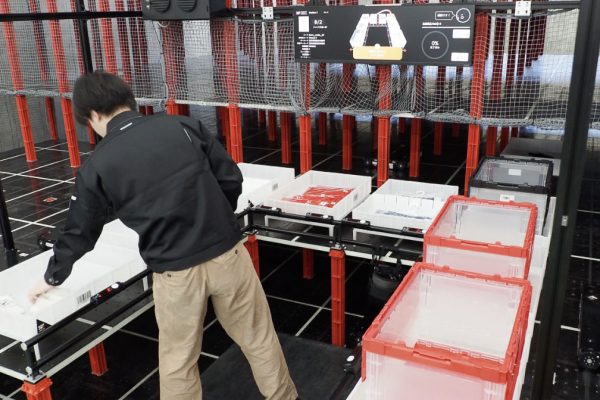
The foundation of multi-client operation is that inventory does not need to be physically split. The Rapyuta Warehouse Management System (WMS) stores and tracks the location of every bin and every SKU. Because the software always knows where everything is, products from different clients can be intermingled across the same modular grid, and the system prioritizes movement based on SKU velocity rather than on which client owns the item.
This has a few practical consequences that matter a great deal to a 3PL operator.
- Intermingled storage, driven by velocity. There is no requirement to reserve a block of the grid for each client. Fast movers, regardless of who they belong to, can sit closest to the picking stations, while slow movers occupy less accessible positions. Storage decisions are made on how inventory actually behaves, not on account boundaries. This is what lets a shared system reach higher density than a set of dedicated zones ever could.
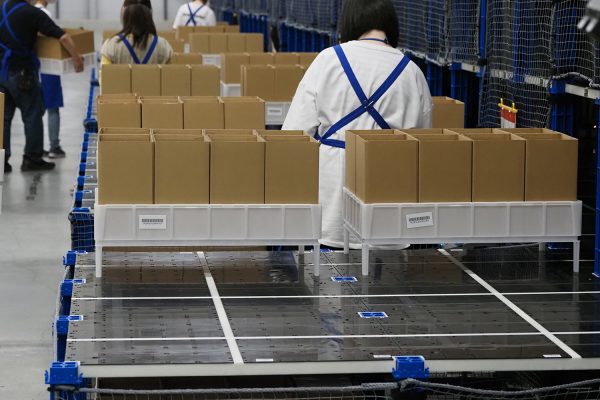
- Intermingled picking, without operator burden. When work reaches a picking station, the operator does not need to keep track of which client an order belongs to. The system sequences and presents the work, and the picker simply follows the projection-guided cues at the station. Orders for different clients can flow through the same station in the same shift, and the WMS handles the separation invisibly, keeping each client’s SLAs in view as it prioritizes.
- Client-specific rules, running side by side. Different clients can operate under different rules on the same system at the same time. One client can run FIFO or FEFO for date-sensitive stock while another runs batch or LIFO logic, with client-specific slotting and velocity handling applied per account. The WMS and the ASRS coordinate all of it, so the physical system stays shared while the operating logic stays tailored.
- Segregated visibility, reporting, and billing. Because everything is tracked at the bin and SKU level with client ownership attached, data can be segregated by customer. That means clean per-client reporting and billing, and it opens the door to giving each client a view, through a dashboard or API, of their own inventory and activity rather than the whole facility. For enterprise clients who expect real-time visibility as a condition of the contract, this is often decisive.
The result is a system that behaves like several purpose-built warehouses stacked into one, without the cost and rigidity of physically building several purpose-built warehouses.
Rapyuta ASRS: Solving the Scaling Puzzle for Multi-Client 3PLs
How modular capacity is reallocated as client volumes change
Logical partitioning solves the day-to-day. The harder question for a 3PL is what happens over months and quarters, as one account ramps up, another winds down, and a third signs on. A shared system is only valuable if capacity can follow the business.
With a modular ASRS, capacity moves along three different levers, each with a different cost and timeline.
- Reslotting happens in software. The most common adjustment does not touch the hardware at all. As a client’s SKU mix or velocity changes, the WMS reslots inventory logically, moving fast movers closer and demoting slow movers, with no physical re-slotting, no floor plan redraw, and no operational downtime. When a new client is onboarded onto space freed up by a departing one, that transition is a software event, not a construction project.
- Adding throughput takes about six to eight weeks. If a client’s order volume outgrows the current picking capacity, throughput can be increased by adding robots and picking stations. This is a modular addition to a running system rather than a rebuild, and it can typically be done in roughly two to three weeks.
- Adding storage takes about six to eight weeks. If the constraint is storage rather than speed, the grid itself can grow. Additional floor tiles are added and new storage positions are created, expanding the system’s capacity. Because the architecture is modular, this happens incrementally, and it typically takes around six to eight weeks.
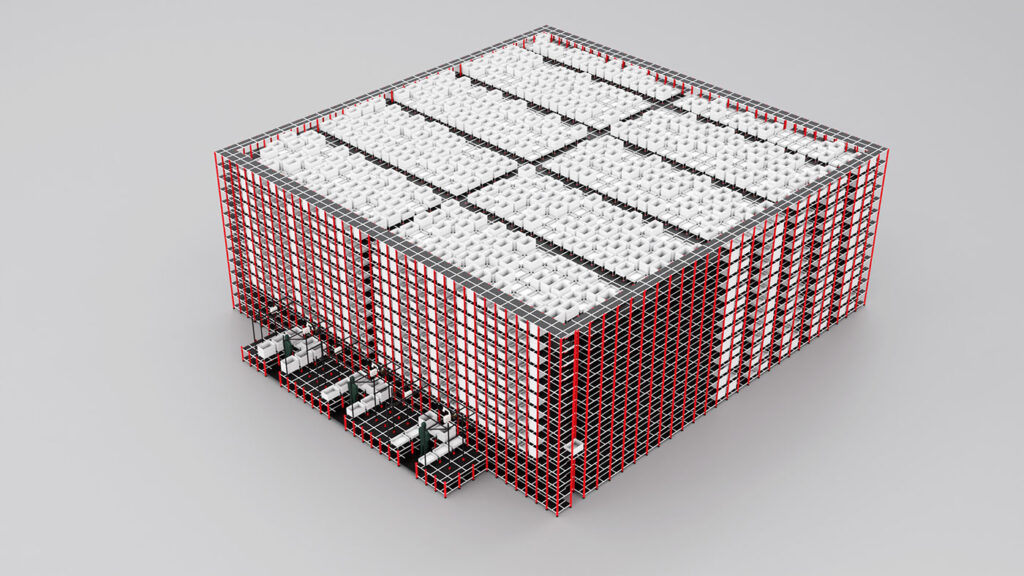
This tiered flexibility is what lets a 3PL start small and grow into demand. A system can begin at a few thousand bin positions to serve an initial book of clients, then scale to tens of thousands of bin positions as the business wins new accounts, all on the same anchorless, modular foundation.
On throughput, the numbers a 3PL can plan around are concrete. Each picking station supports up to 400 bin deliveries per hour, and the system handles 240 bins per hour per station across combined inbound and outbound flows. Because the ASRS is goods-to-person, this throughput holds without the walking, searching, and fatigue that cap manual operations, and it stays consistent across the peaks and lulls that come with juggling multiple clients.
Why automation is now a prerequisite for winning enterprise 3PL contracts
In sales conversations with 3PL operators, the buying trigger is rarely a single feature. It is flexibility and scalability, framed as risk reduction. Automation is a large commitment, and 3PLs are trying to de-risk these projects as much as possible, because they are placing a bet on infrastructure while their client contracts turn over.
A modular ASRS answers that concern directly. Because a 3PL can start at a few thousand bin positions and scale to tens of thousands without replacing the system, the initial commitment is sized to today’s book of business rather than a speculative future. Growth is additive, not a rip-and-replace. That changes the risk calculation for a provider who cannot perfectly predict which clients they will be serving in three years.
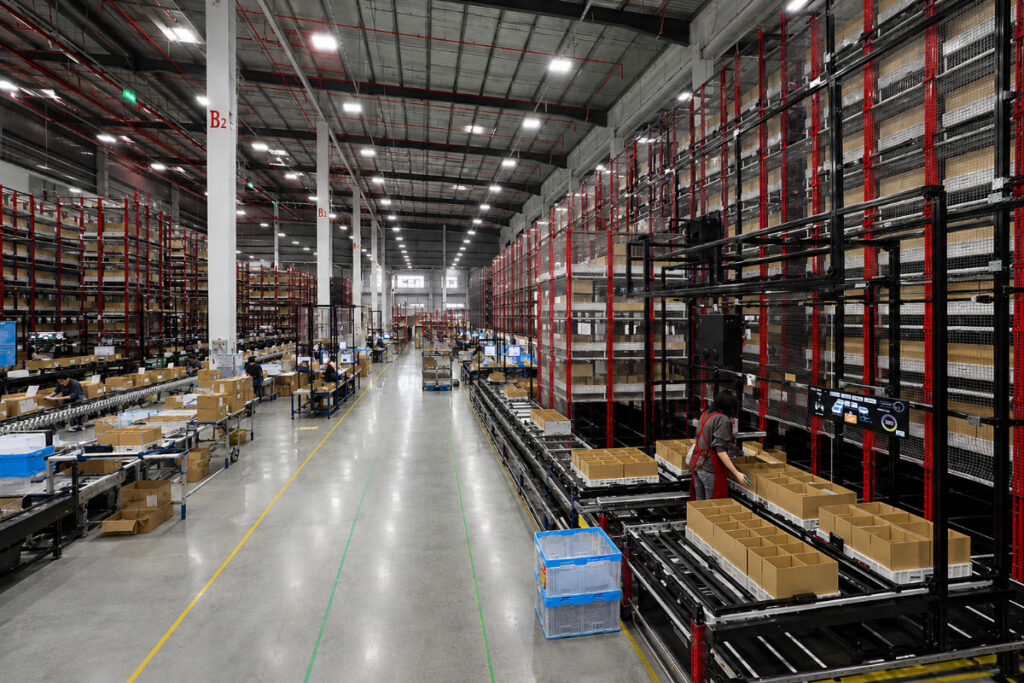
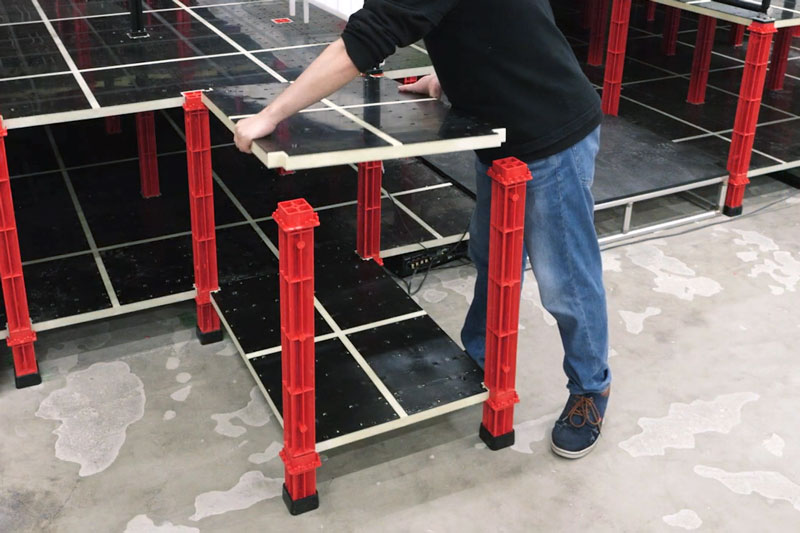
The anchorless, modular design compounds this advantage in a way that matters specifically for 3PLs, who so often operate in leased and irregular buildings. Because the structure is freestanding and bolt-free, it can be installed without structural modification to the facility, and it can use space that other ASRS designs simply cannot. It conforms around columns, beams, and fire shutters, spans multiple floors, and can be built onto mezzanines or over office areas, turning previously wasted volume into storage. For a 3PL trying to extract maximum capacity from a fixed lease, that reclaimed space is real capacity and real margin.
Put together, these capabilities are increasingly what enterprise shippers expect from a logistics partner. When a large client evaluates a 3PL, they are assessing whether the provider can protect SLAs as order profiles grow more complex, absorb seasonal surges without dropping accuracy, and give them real-time visibility into their own inventory. A provider running on manual, static infrastructure struggles to credibly promise any of that. A provider running modular, multi-client automation can put it in the contract.
Addressing the single point of failure concern
There is one objection worth meeting head-on, because thoughtful operators raise it every time. If a 3PL routes multiple clients through one automated system, does that system become a single point of failure, where a structural problem halts every client’s operation at once?
It is the right question, and the Rapyuta ASRS is engineered with layered redundancy so that the answer holds up under scrutiny.
- Backup power for servers. The control layer is protected by backup power, so a power event does not immediately take the brains of the system offline.
- Redundant network connections, and the ability to run without a network. Network connectivity is built with redundancy, and importantly, the ASRS can continue operating even without a network connection. Connectivity loss does not equal a stopped operation.
- Localized collision isolation. If a collision or fault occurs on the floor, only the small affected grid is blocked off. The rest of the structure keeps running. A localized issue stays localized rather than cascading into a full-facility stoppage.
- Remote access and support. Remote access options allow issues to be diagnosed and addressed quickly, shortening the path from problem to resolution.
The point is not that failures never happen. It is that the system is designed so that a fault degrades gracefully in one small area rather than stopping every client at once. For a shared-infrastructure 3PL, that difference is the whole argument.
The bottom line
For a 3PL, the promise of shared-infrastructure automation is simple to state and hard to deliver: run many clients, with many different needs, on one system that flexes as the business does. A modular ASRS delivers on that promise by separating clients in software rather than in concrete, reallocating capacity through reslotting, added robots, or added tiles as volumes shift, and scaling from a few thousand to tens of thousands of bin positions on the same anchorless foundation.
That is what turns automation from a cost center into a competitive weapon. It lets a 3PL commit to enterprise SLAs with confidence, win space in leased buildings that competitors cannot use, and onboard new clients as a software event rather than a construction project. In a market where physical space and human labor no longer scale with complexity, that flexibility is the difference between growing horizontally, and running out of room, and growing vertically, with room to spare.
Talk to us
If you are a 3PL evaluating how to serve more clients on the same footprint, or trying to de-risk your first automation project, let’s map your client mix and growth plan to a modular ASRS configuration that scales with you. Contact the Rapyuta Robotics team to start the conversation.
FAQs
- How does a multi-client ASRS keep one client’s inventory separate from another’s? Separation is handled logically, in software, not physically. The WMS tracks the location and ownership of every bin and SKU, so products from different clients can share the same grid while remaining fully distinct for storage, picking, reporting, and billing. There is no need to dedicate physical zones to each client.
- Can different clients use different inventory rules on the same system? Yes. Clients can run different rules simultaneously, for example FIFO or FEFO for one account and batch or LIFO for another, with client-specific slotting and velocity logic. The WMS and ASRS apply the correct rules per client on shared hardware.
- What happens when one client grows and another shrinks? Most adjustments happen in software through reslotting, with no downtime. If a client needs more throughput, robots and picking stations can be added in roughly six to eight weeks. If more storage is needed, additional tiles and storage positions can be added in roughly six to eight weeks.
- How much throughput can each station handle? Each picking station supports up to 400 bin deliveries per hour, and the system handles 240 bins per hour per station across combined inbound and outbound flows.
- Isn’t a shared automated system a single point of failure for all clients? It is designed to avoid that. The system includes backup power for servers, redundant network connections, and the ability to operate without a network. If a collision occurs, only a small grid is blocked off while the rest of the structure keeps running, and remote access options speed up resolution. Faults are contained locally rather than halting every client at once.
- Can a modular ASRS fit into a leased or irregular warehouse? Yes. The anchorless, modular design is freestanding and installs without structural modification. It can conform around columns, beams, and fire shutters, span multiple floors, and be built onto mezzanines or over office areas, making use of space other ASRS systems cannot.