The picking station is where an automated warehouse turns robot performance into shipped orders. Modern fulfillment operations need faster, more accurate picking to keep up with high order volumes and rising customer expectations. Traditional picking setups are still held back by sequential bin delivery, conveyor dependencies, and operator idle time.
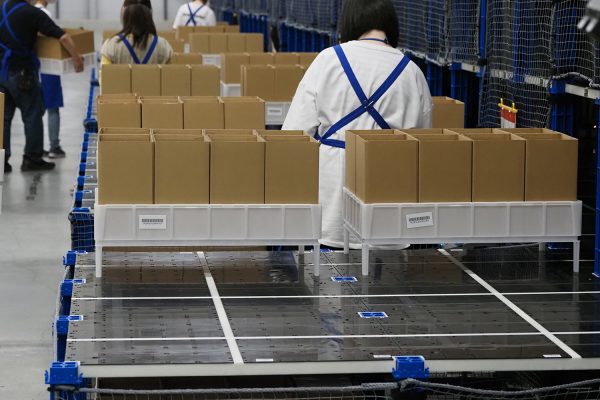
The Rapyuta ASRS picking station takes a modular, operator-centric approach built on ergonomics, flexibility, and simplicity. Multiple bins are presented in parallel, so operators can pick multiple SKUs in a single cycle. Outbound bins are integrated into the station, which removes unnecessary hand-offs. Autonomous robots deliver bins directly to the operator, which reduces idle time, keeps mechanical complexity low, and raises throughput.
Key takeaways from this article:
- Throughput without extra footprint: More lines picked per hour without expanding floor space.
- Layout agility: A modular, multi-floor design that grows with your product mix and order volume.
- Intelligent orchestration: Every robot, bin, and operator is put to full use, which reduces operator idle time and raises output.
- CapEx protection: Invest once. Operate with people today and add robotic picking later with minimal changes.
- Reduced operational risk: Simpler flows mean fewer points of failure, less disruption, and higher uptime.
The Design Intent
Rethinking ASRS with Simplicity at the Core
E-commerce and logistics operations have outgrown traditional warehouse workflows. Many goods-to-person systems still rely on sequential bin delivery and multiple transfer stages, such as extra conveyors and manual lifting, to get products in front of pickers. This leads to:
- Idle time at the picking station while the operator waits for the next bin.
- Mechanical complexity that raises cost and constrains flow.
- Separate mechanisms for handling SKU bins and order bins.
When we set out to design our automated storage and retrieval system (ASRS), we defined three clear requirements for the picking station:
- Ergonomics first: Surround the pick associate with every SKU bin and order bin, each within a single step’s reach, for efficiency and comfort.
- Flexibility: Add or remove every bin independently, as needed.
- Simplicity: Achieve both without introducing complex or expensive mechanical elements.
Conventional systems rely heavily on conveyors and extra mechanical elements. We challenged ourselves to avoid that complexity. The constraint was tough, but it led us to a design that fits our core value:
Simplicity in design
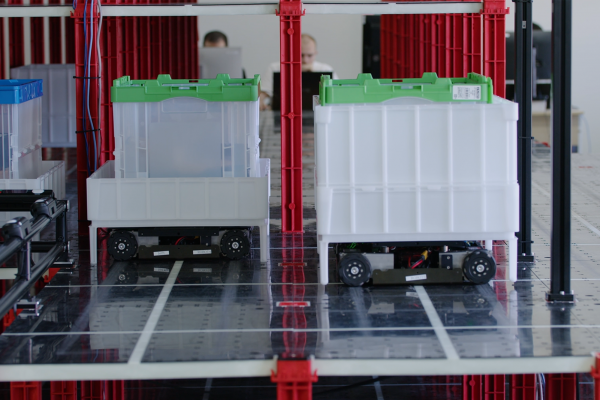
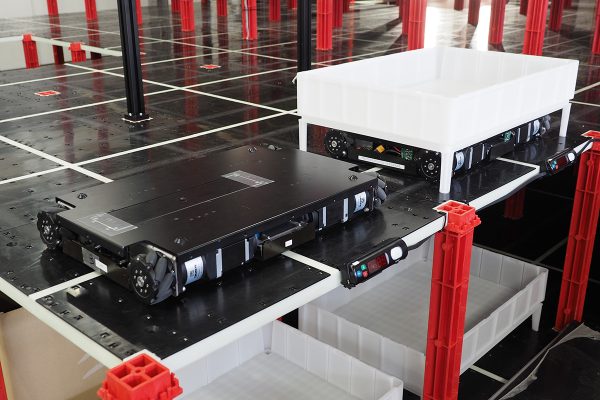
Our approach was straightforward. We extended the modular structure’s tiles beyond the structure to bring the bins directly around the pick associate. Robots deliver bins right to the workstation without any intermediate hand-off, which saves time and removes complexity. Robots also move each bin in and out independently, a level of flexibility that is difficult to achieve with traditional conveyor setups.
To improve safety and usability, we added a few carefully chosen mechanical and digital assistive elements, shown in the illustration below:
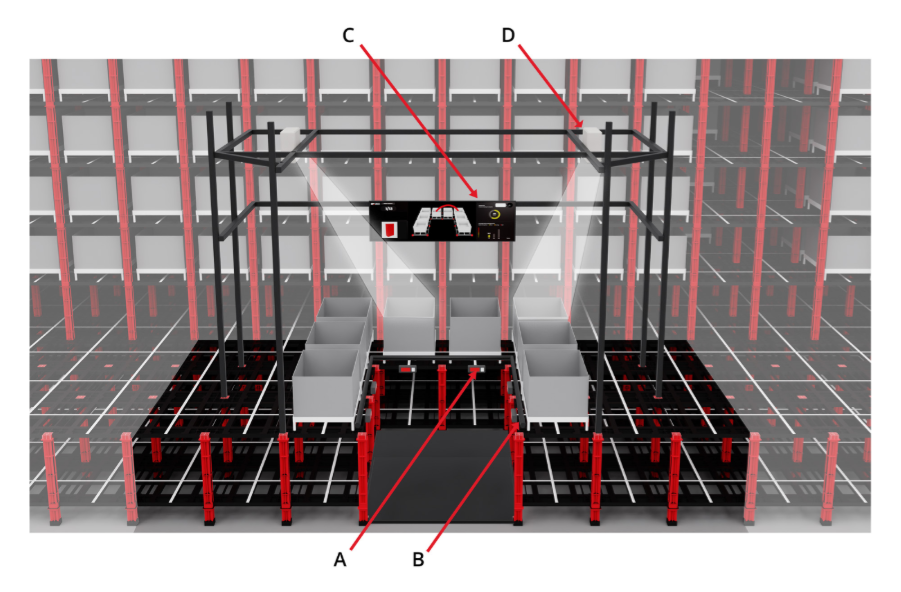
- A: Colored LED buttons in front of each bin guide picks and confirm completion.
- B: A small safety fence lets robots and people work alongside each other.
- C: A monitor provides additional guidance, such as SKU images. Most associates rely mainly on the projector and buttons.
- D: A projector highlights the pick bin and the destination bin for intuitive interaction.
Why the Picking Station Is the Profit Center
The picking station is the “cash register” of any automated warehouse. It is where robot performance finally becomes shipped orders. If the station is inefficient, even advanced robotics upstream end up underutilized.
The Rapyuta ASRS picking station changes that equation:
- Multiple bins presented in parallel at each picking station.
- Storage bins and outbound shipment bins handled together on a single floor, with no extra lifts or conveyors.
- Operators, robots, the station, and the central server synchronized and controlled by our distributed software stack.
Core Picking Station Architecture
U-shaped picking station
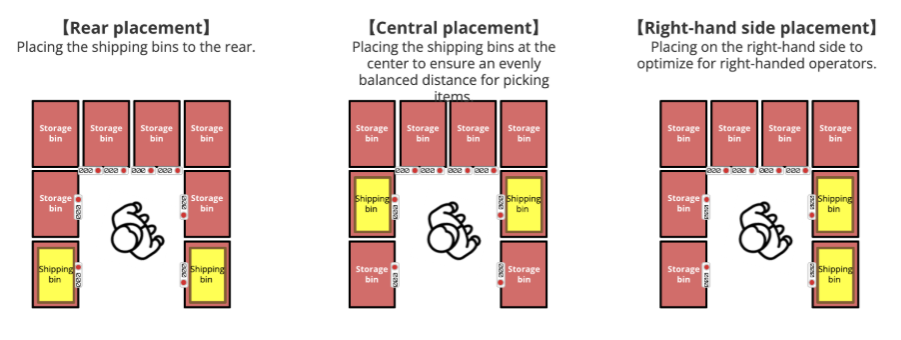
- Multiple Pick Positions, a Single Step Away: Several bins are presented at once, so operators can pick multiple SKUs in a single cycle.
- Optimized Shipping Bin Placement: Shipping bins can sit at the rear, in the center, or on the right-hand side. Each option balances picking distances and lets the station adapt to the operator and the workflow.
- Integrated Loading Positions: Outbound shipment bins sit next to the picking positions, so transport robots handle both source bins and outbound bins without extra systems. This speeds up picking.
- Close Integration: Our picking stations sit much closer to both the storage structure and the robots than other systems do. This tightens integration and saves floor space.
- Vertical System Support: Elevators move bins between floors, which makes vertical storage scalable.
I-shaped picking station
Pick to DAS (Digital Assort System)
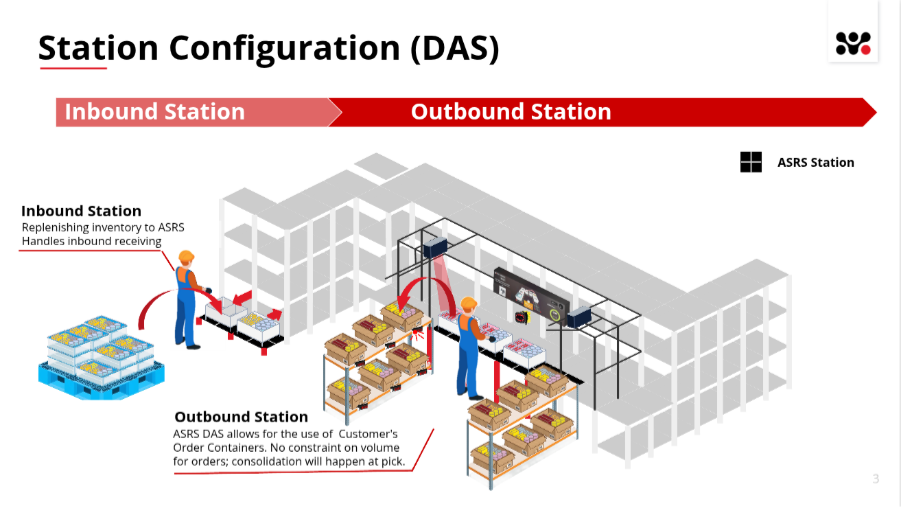
- One Bin, Many Orders: The robot presents one SKU bin at the pick position. The operator distributes its units across every order that needs that SKU before the bin returns to storage. This reduces total bin trips per wave.
- Light-Guided Put to Order: DAS indicators show the operator which order slot receives each unit and how many. The wall guides put accuracy at the moment of the pick.
- Consolidation Outside the Structure: Orders build at the DAS wall, so the ASRS does not hold order bins in storage while they wait for remaining lines. Storage capacity stays dedicated to inventory.
- Straight-Line Layout: The station runs along the edge of the storage structure with the DAS wall placed directly opposite the pick position. Operators pick and put within a few steps.
- Built for E-commerce Order Profiles: Suited to high order counts of small, multi-line orders, where the same SKU appears across many orders in a single wave.
- Vertical System Support: Elevators move bins between levels at 3.22 ft/s (0.98 m/s), so the full storage height feeds a single pick position.
Pick to External Interface
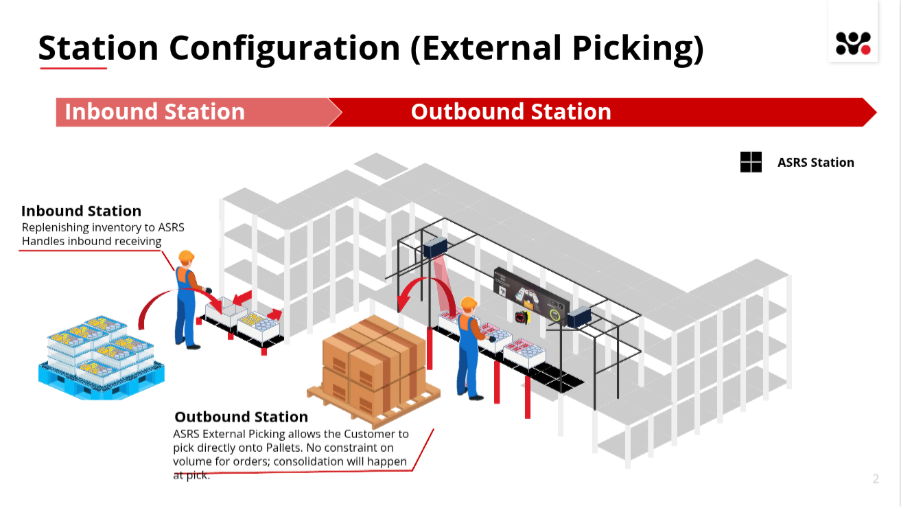
- Direct Handoff to Downstream Equipment: Operators pick from the bin straight to a pallet, conveyor, or cart. Goods leave the system at the point of pick.
- No Buffering Step: There are no order bins, no put wall, and no consolidation inside the structure. Each pick moves directly to the next process.
- Works With Existing Infrastructure: The station connects to conveyor and palletizing equipment the site already runs. This suits brownfield facilities adding dense storage without replacing downstream handling.
- Case Pick Ready: Supports case picking to a pallet for store replenishment or to a takeaway conveyor for packing. Each bin carries up to 66 lb (30 kg) of goods.
- Straight-Line Layout: The station sits along the structure edge with the external interface directly in front of the operator, keeping the pick-to-place distance short.
- Human and Automation Flexibility: Designed for human operators today, with the pick position structured for robotic arm integration as that capability matures.
Conclusion
An ASRS is only as productive as its picking station. Robots can deliver bins quickly, but orders ship only as fast as operators can pick them. That is why we designed the Rapyuta ASRS picking station around three requirements: every bin within one step of the operator, independent movement for every bin, and as few mechanical elements as possible.
Robots bring SKU bins and order bins straight to the station, with no conveyors or intermediate hand-offs in between. A projector, LED buttons, and a monitor guide each pick, and our distributed software stack keeps operators, robots, and the central server in sync.
The same modular structure supports more than one station layout. The U-shaped station surrounds the operator with multiple SKU bins and order bins for multi-SKU picking in a single cycle. The I-shaped station runs in a straight line along the edge of the structure and comes in two forms. Pick to DAS distributes one SKU bin across many orders at a light-guided wall. Pick to External Interface hands goods directly to a pallet, conveyor, or cart. Every layout is designed for human operators today and structured for robotic arm integration as that capability matures.
The right layout depends on your order profile: how many lines each order carries, how often the same SKU repeats across orders in a wave, and where goods need to go after the pick.
Part 2 of this series, How the Pieces Fit Together and the Strategic Advantage of Rapyuta’s ASRS Picking Station, explains how these components work together as one system.
Frequently Asked Questions
What is an ASRS picking station? An ASRS picking station is the workstation where an automated storage and retrieval system delivers bins to an operator for picking. In the Rapyuta ASRS, robots bring SKU bins and order bins directly to the station, so the operator picks without waiting on conveyors or intermediate hand-offs.
What is the difference between a U-shaped and an I-shaped picking station? A U-shaped station surrounds the operator with multiple SKU bins and order bins, each within one step, so the operator can pick multiple SKUs in a single cycle. An I-shaped station runs in a straight line along the edge of the storage structure and feeds either a DAS wall or downstream equipment such as a pallet, conveyor, or cart.
What is Pick to DAS (Digital Assort System)? Pick to DAS is an I-shaped station layout that works like a put-to-light wall. The robot presents one SKU bin, and the operator distributes its units across every order that needs that SKU. Indicators on the DAS wall show which order slot receives each unit and how many. Orders build at the wall, so storage capacity stays dedicated to inventory.
Can an ASRS picking station connect to existing conveyors and palletizing equipment? Yes. The Rapyuta Pick to External Interface station connects to the conveyor and palletizing equipment a site already runs. Operators pick from the bin straight to a pallet, conveyor, or cart. This suits brownfield facilities that want dense storage without replacing downstream handling.
Can robotic arms pick at the Rapyuta ASRS picking station? The stations are designed for human operators today, with the pick position structured for robotic arm integration as that capability matures. A site can invest in the station once and add robotic picking later with minimal changes.