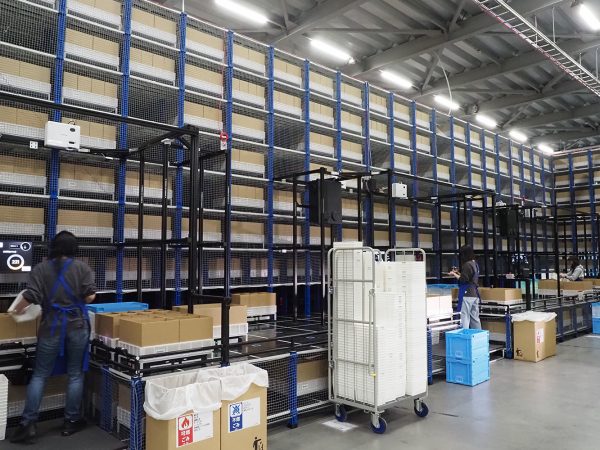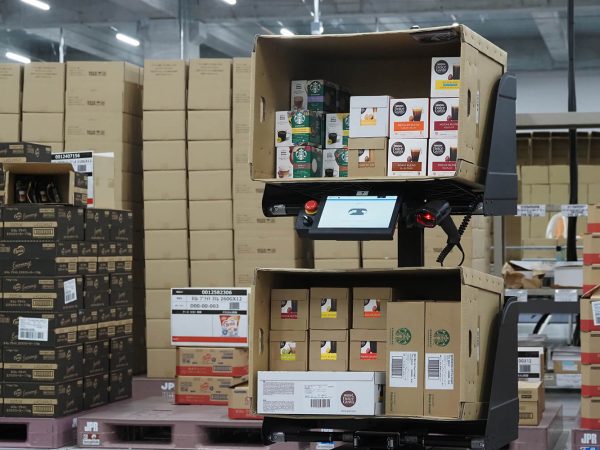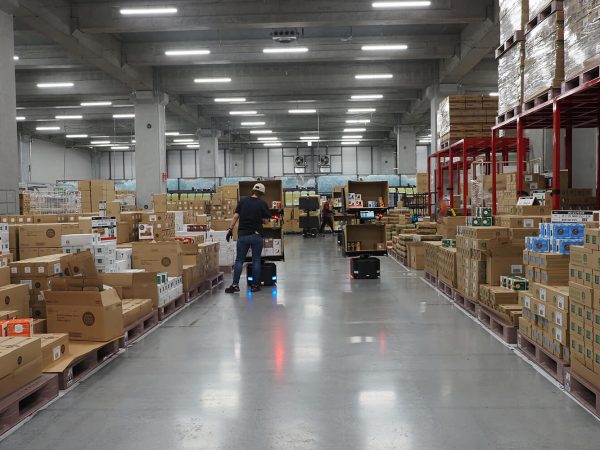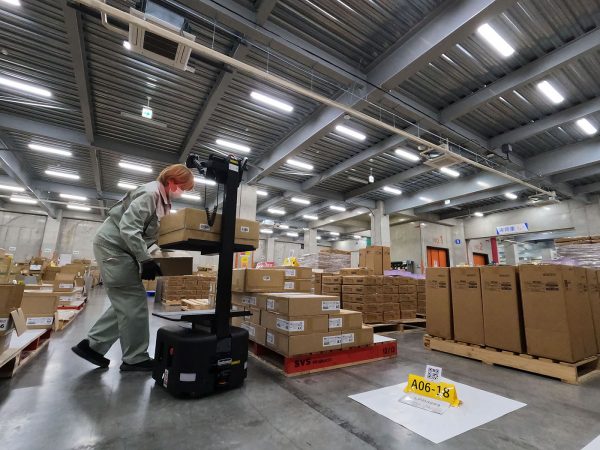
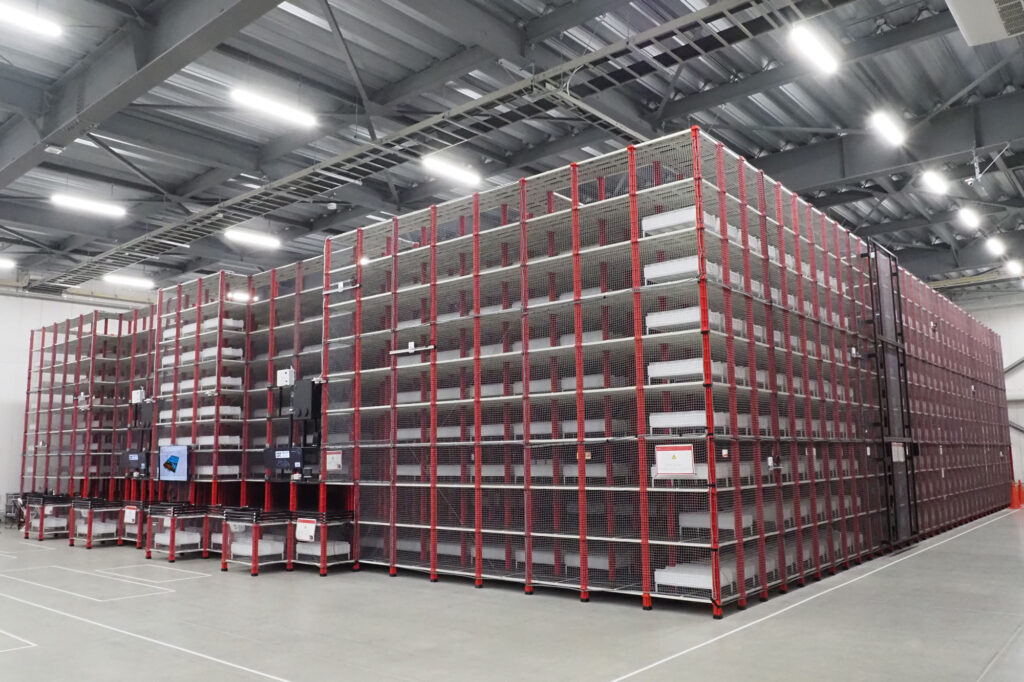
Alps Logistics Co., Ltd.—a global third-party logistics provider under LOGISTEED, Inc.—handles the full spectrum of logistics services: storage, transportation, and international freight forwarding across Japan and overseas. In May 2025, the company deployed Rapyuta ASRS, a modular automated storage and retrieval system at its Daiei Warehouse in Narita, Chiba.
This wasn’t Alps Logistics’ first automation project. They’ve been implementing ASRS solutions since 2020. But their latest deployment with Rapyuta represents a different approach, one driven by specific constraints around labor, facility flexibility, and the need to maintain control of their own warehouse management system.
Here’s how they got there and what made Rapyuta ASRS the right fit.
Project Snapshot: Daiei Warehouse
- Location: Narita, Chiba, Japan
- Business: Integrated logistics (3PL)
- Deployment Type: New warehouse (greenfield)
- Go-Live Date: May 2025
- Product Line: Electronic components
ASRS Configuration:
- Footprint: ~3,875 square feet
- Ceiling Height: ~18–20 feet
- System Levels: 9
- Robots: 16 units
- Lifts/Elevators: 4 units
- Storage Bins: 4,000
- Picking Stations: 2 units
- Target Productivity: Not disclosed
The Backstory: Labor Problems Getting Worse, Not Better
Alps Logistics isn’t new to warehouse automation. They’ve been at it since 2020, with their first bin-based ASRS for piece picking, followed by two more deployments in 2024. But automation for them isn’t about chasing the latest technology, it’s about solving a fundamental business problem that keeps getting harder: finding and keeping qualified warehouse workers.
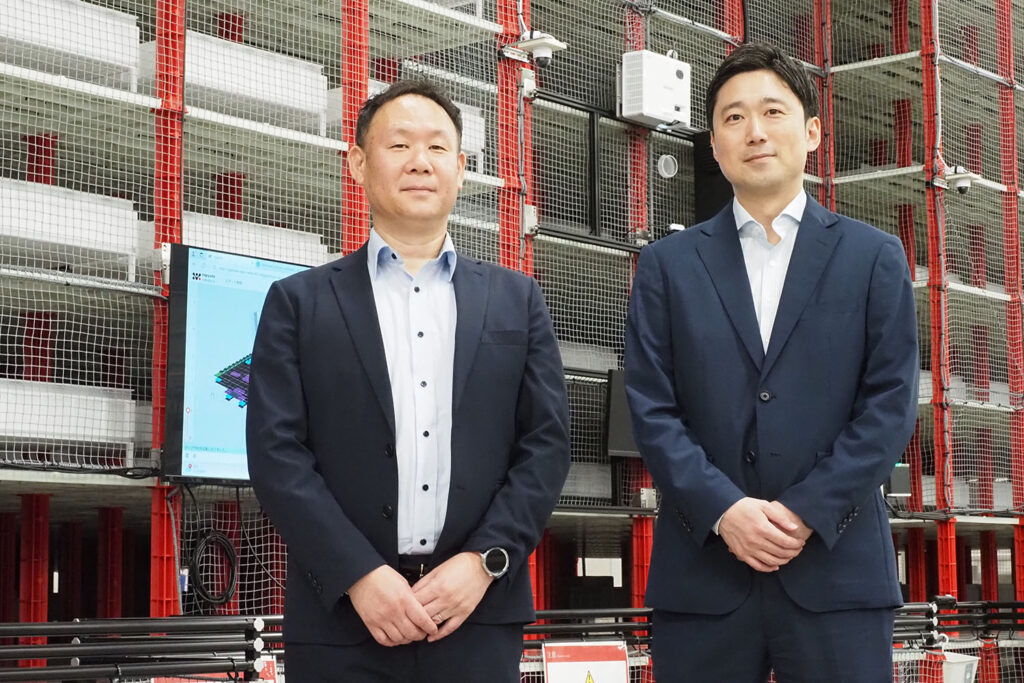
Masanori Nodono, General Manager of the Storage Business Unit, explains the pressure they’re facing:
“We’ve entered an era where recruiting is hard and we’re seeing first-hand how much tougher it gets over the next five to ten years. In our case, unlike many e-commerce operations, we handle precision components. That means strict temperature and humidity control and dust protection, and vibration mitigation. We also work with tens of thousands of SKUs, and not all of them carry barcodes or UPC codes. As a result, our workflows are more complex than a typical warehouse, and training takes time. Some tasks can’t be handled by short-term hires; we need people who will stay. But attracting and retaining strong long-term talent has become increasingly difficult in recent years.”
This isn’t just about headcount, it’s about complexity. When you’re handling precision electronic components with strict environmental controls and dealing with tens of thousands of SKUs that may not even have standard barcodes, you can’t just throw temp workers at the problem. You need trained, experienced people who understand the operation. And those people are harder to find every year.
Against that backdrop, Alps Logistics opened the Daiei Warehouse in May 2024 near Narita Airport as a consolidation play bringing two external warehouses into a single, more efficient hub. And they decided this new facility would be the right place for their first Rapyuta ASRS deployment.
The Challenge: Capacity Constraints and Non-Negotiable Software Requirements
The Daiei Warehouse serves the Narita branch, which handles stock and delivery of electronic components for export. Before Daiei opened, Alps Logistics was running two external warehouses near the airport, and both were maxed out.
Mr. Nodono:
“Both external warehouses were already at full capacity, and we couldn’t take on additional volume. By consolidating two sites into Daiei, our goal was to improve efficiency and expand operations.”
So, the business need was clear: consolidate, increase capacity, and do it more efficiently than before. But there was another requirement that shaped the entire vendor selection process that is Alps Logistics runs its own enterprise WMS called ACCS (Alps Cargo Center System) globally, and they weren’t willing to compromise on it.
Mr. Nodono is direct about this:
“We’ve used our own WMS for decades and continually fine-tuned it to drive efficiency. We want our own WMS to orchestrate the ASRS. If a vendor insists, we must use the ASRS vendor’s WMS, our answer is no. Some vendors won’t customize at all, others will ‘do a little,’ but that leads to dual operations, extra clicks, and unnecessary effort. From a total-efficiency standpoint, the best outcome is to run entirely on our WMS and have the ASRS system work with it. That’s the kind of system we need.”
Masahiro Watanabe, Manager in the Corporate Planning Department, breaks down what that means in practice:
“A WMS must receive goods, store them, allocate inventory from multiple locations when an order comes in, then manage picking, packing, and shipping. ACCS is our in-house system; we know it well and run it efficiently. If the ASRS software is flexible, we can pass only the computed results from our side to the ASRS. In other words, we keep using our highly optimized, customized WMS, while the ASRS uses the control layer that lets the ASRS run at peak efficiency. That kind of customization is what works best for us.”
This is a critical point that many warehouse operators will recognize: most ASRS vendors want you to use their WMS, or at minimum, their execution layer. For a company like Alps Logistics that’s spent decades building and refining their own system, that’s a non-starter. It’s not about ego, it’s about operational efficiency and the ability to scale that efficiency across multiple sites globally.
Mr. Nodono adds another layer to why ACCS integration matters so much:
“Once ACCS is customized to integrate with an ASRS, the same integration can be rolled out laterally to future sites. Alps Logistics already operates ACCS company-wide and globally, so when personnel transfer between domestic and overseas locations, they continue using the same system and remain productive from day one. The same holds true when opening new sites: while most companies need time to ramp up to a steady-state efficiency, Alps Logistics has built a structure that enables high-efficiency operations from launch, regardless of region.”
So, the ASRS selection wasn’t just about this one warehouse. It was about finding a solution that could integrate with their global operating model and scale across future deployments without reinventing the wheel every time.
The Decision: Balancing Storage Density, Throughput, and Software Flexibility
Alps Logistics had experience with ASRS implementations, so they knew what questions to ask. Mr.Nodono walks through their evaluation criteria:
“In the past, we tended to pick an ASRS based on how many orders it could process per day. But after implementing and operating other systems, we learned that the real key is having both high in/outbound throughput and strong space efficiency. That combination delivers the greatest impact, so we compared vendors most carefully on those two axes. Some systems are extremely fast but don’t use space well; others pack densely but are slow. Rapyuta ASRS had the best balance of processing capacity and storage density, and it fit perfectly with our inventory volumes and inbound/outbound requirements. And the flexibility of their software that allows us to operate the ASRS on our own WMS is another decisive factor. Those are the reasons why we chose Rapyuta.”
This is a mature buying decision from a company that’s lived through multiple automation projects. They’re not chasing the highest throughput number or the densest storage configuration; they’re looking for the right balance for their specific operation. And critically, they need software flexibility that most ASRS vendors won’t provide.
But there was one more factor that sealed the deal: the physical installation requirements or rather, the lack of them.
Mr. Nodono:
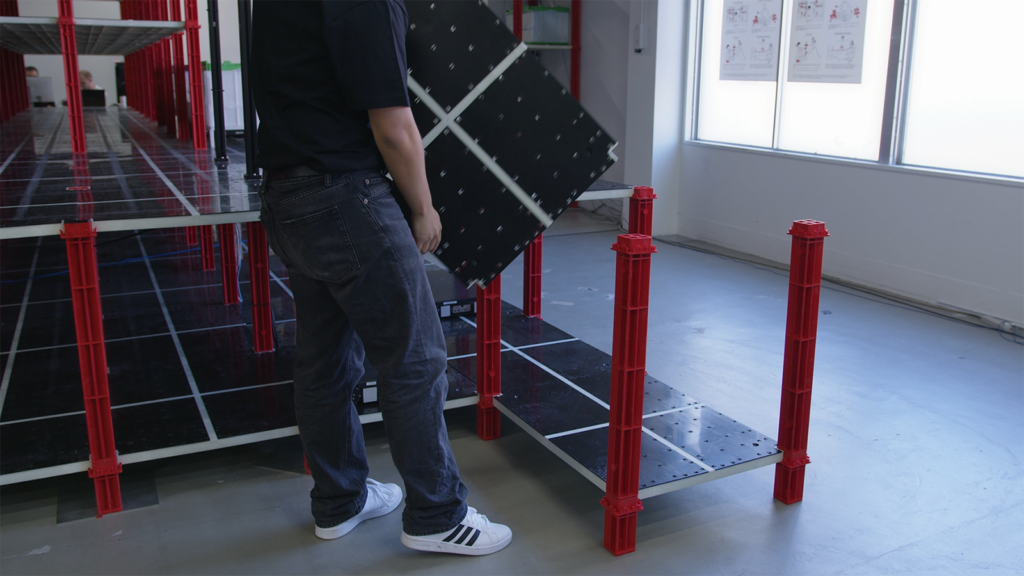
“Two things stood out: strong storage efficiency plus processing capacity, and the fact that the structure is seismic-isolated without floor anchors. Our previous ASRS was installed in a warehouse we owned, but this time we’re in a leased facility with make-good obligations. If anchors were required, the barrier to adoption would be much higher. And if we ever need to relocate or consolidate to another site, Rapyuta ASRS can move with us. That flexibility was also a major reason for our choice.”
This matters more than most operators might initially think. If you’re in a leased facility, especially in markets like Japan where seismic requirements are strict – permanent floor anchoring creates significant barriers. It limits where you can install the system, it creates restoration obligations when you leave, and it makes the system essentially immovable if your business needs change.
Rapyuta ASRS uses a seismic-isolated, anchorless structure. It’s engineered to meet safety requirements without becoming part of the building’s permanent infrastructure. That means Alps Logistics can install it in leased space, move it to another facility if they consolidate operations again, or reconfigure the layout as their business evolves.
What Makes Rapyuta ASRS Different: Breaking the Storage-vs-Speed Trade-off
In most warehouse operations, there’s a fundamental trade-off: you can push for maximum throughput, which requires maneuvering space and reduces storage density, or you can maximize storage density, which typically slows down throughput because you’ve got less room to maneuver.
Rapyuta ASRS was designed to break that trade-off. The system delivers both high storage density and high processing capacity without forcing operators to choose one over the other.
How? The modular, block-based design allows for flexible configuration—you can optimize the layout for your specific mix of storage and throughput requirements. And because it’s anchorless and seismic-isolated, you’re not locked into your initial configuration. If your business mix changes and you need to adjust the balance between storage and speed, you can reconfigure the system without tearing out permanent infrastructure.
This modularity also extends to the workflow. Post-pick activities like sorting, consolidation, and outbound sequencing can be automated inside the ASRS itself, rather than requiring separate downstream systems. That flexibility was valuable to Alps Logistics, given the complexity of their electronic component handling requirements.
Automation That Works with People, Not Instead of Them
Both Rapyuta Robotics and Alps Logistics share a similar view on automation—it’s not about eliminating people; it’s about creating better working environments and making operations sustainable in the face of labor constraints.
For Alps Logistics, automation is driven by necessity. They can’t find enough qualified workers to handle complex operations, and the demographic trends in Japan aren’t improving. But their goal isn’t a lights-out facility—it’s an operation that can function efficiently with the workforce they can realistically recruit and retain.
For Rapyuta, that philosophy shaped the design of the ASRS itself. By making the system anchorless and relocatable, by allowing integration with customer WMS systems rather than forcing platform lock-in, and by building in configurability that lets operators adapt as their needs change, the technology becomes more accessible to a wider range of facilities and use cases.
The result is automation that fits the operation, rather than forcing the operation to fit the automation.
What This Means for 3PL and Contract Logistics Operators
Alps Logistics’ experience offers several relevant insights for other logistics providers evaluating automation:
1. Software integration is as important as hardware performance. If you’ve invested in building and refining your own WMS, finding an ASRS vendor willing to work with it, rather than forcing you onto their platform is critical. Dual systems create friction, extra clicks, and inefficiency that undermines the whole point of automation.
2. The right metrics matter more than the biggest numbers. Alps Logistics learned from past deployments that raw throughput or maximum storage density alone doesn’t tell you much. What matters is the right balance for your specific volumes and SKU mix, combined with software flexibility that lets you run the system the way you need to.
3. Facility flexibility is a real constraint in leased spaces. If you’re in leased facilities—especially in markets with strict seismic requirements, permanent floor anchoring creates significant barriers to adoption and limits your future flexibility. Anchorless, relocatable systems open up more deployment options.
4. Scalability across sites depends on standardization. For multi-site operators like Alps Logistics, the ability to replicate a WMS integration across locations without custom work every time is a major advantage. It reduces implementation time, maintains operational consistency, and keeps workers productive when they transfer between facilities.
5. Labor constraints aren’t going away. For operations handling complex products that require trained, experienced workers, the demographic trends aren’t improving. Automation that reduces headcount requirements while redeploying people to higher-value tasks isn’t optional anymore; it’s a business continuity strategy.
What’s Next
Alps Logistics’ Daiei Warehouse went live with Rapyuta ASRS in May 2025. As the operation matures and performance data becomes available, we’ll share follow-up updates on operational outcomes, throughput metrics, and lessons learned from real-world operations.
For a company that’s been implementing automation since 2020, this deployment represents not just another ASRS installation, but a different approach, one that prioritizes software flexibility, facility adaptability, and the ability to scale efficiently across a global operation.
Stay tuned for performance results as they emerge from live operations.