New pickers matched experienced output on the robots, and the center absorbed rising order volume without adding people
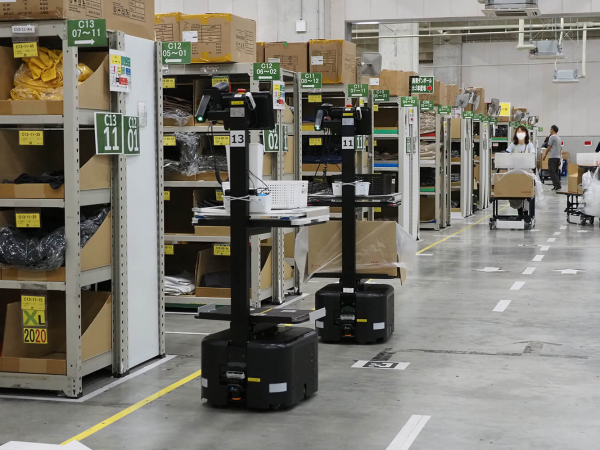
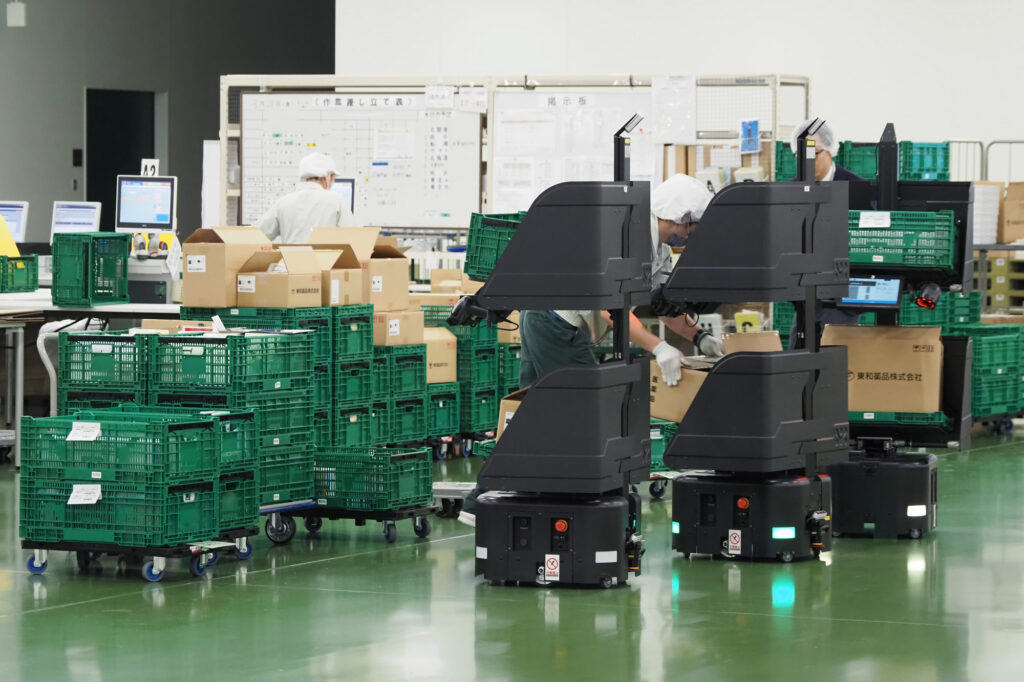
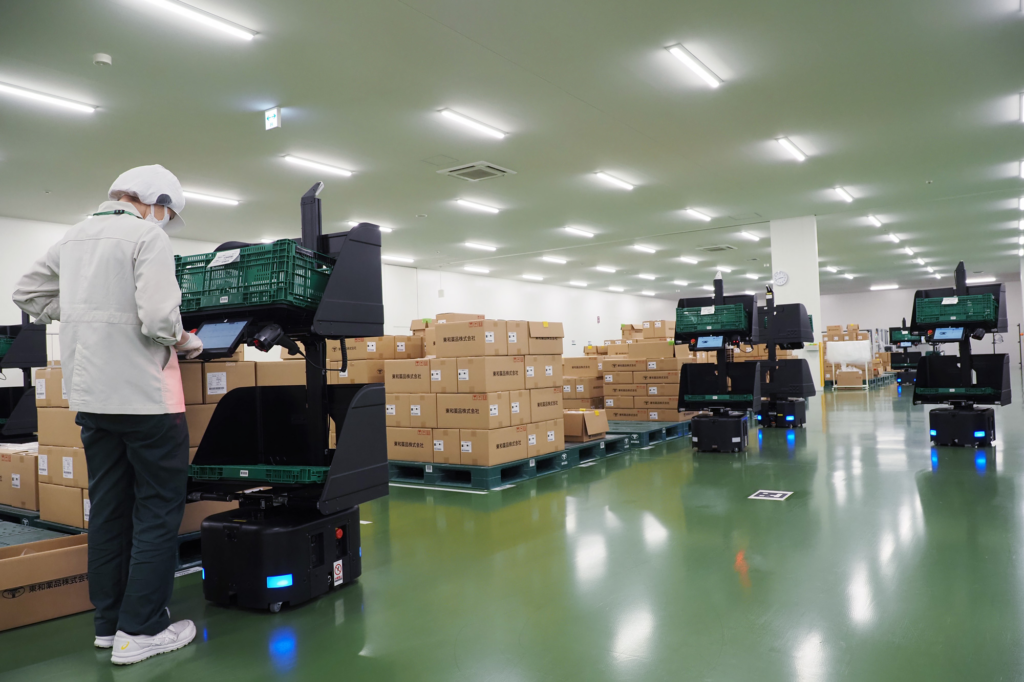
Towa Pharmaceutical Co., Ltd. manufactures and sells prescription generic pharmaceuticals. In October 2024 it put 10 Rapyuta PA-AMR XL pick-assist robots into the picking operation at its East Japan Distribution Center in Yamagata City, Japan. Pharmaceutical distribution runs under strict quality standards, and uninterrupted supply is not negotiable, so the center could not pause shipping to install anything. We interviewed the three people who ran the project: the floor leader, the project manager, and the systems lead.
Summary
Here is what the center has to show for the first months of live operation.
- Shipping continued throughout the deployment: The center kept cart picking running alongside the robots rather than converting fully, every trouble event had a fallback, and pharmaceutical shipping was never interrupted.
- Staffing got easier to plan: The pilot confirmed that a new employee on AMR picking produces at the same level as an experienced picker, so the center put new hires on the robots and kept its most experienced people on cart picking, which is the harder work to learn.
- Order volume grew, and headcount did not: Inbound and outbound work went up, and the center absorbed it without falling short on people. The team frames the win as reducing effort rather than reducing staff.
- The physical work got lighter: Associates were freed from manual loading and unloading work and from pushing heavy picking carts., and Rapyuta lowered the XL’s upper tray by about 6 inches at the center’s request, which the floor leader credits with a real productivity contribution.
- The center gained live visibility it did not have: Robot data made work status visible in real time, which the team called a bigger return from the pilot than the productivity number was.
- The core WMS and storage locations remained largely unchanged: The center improved the operation without making major changes to its existing WMS or storage locations, while building its own integration API where needed.
Towa Pharmaceutical Co., Ltd., East Japan Distribution Center
Location: Yamagata City, Yamagata Prefecture, Japan
Business: Manufacture and sale of prescription pharmaceuticals
| ROBOTS DEPLOYED 10 PA-AMR XL | LIVE SINCE October 2024 | PICKING AREA 16,100 sq ft (1,500 m²) |
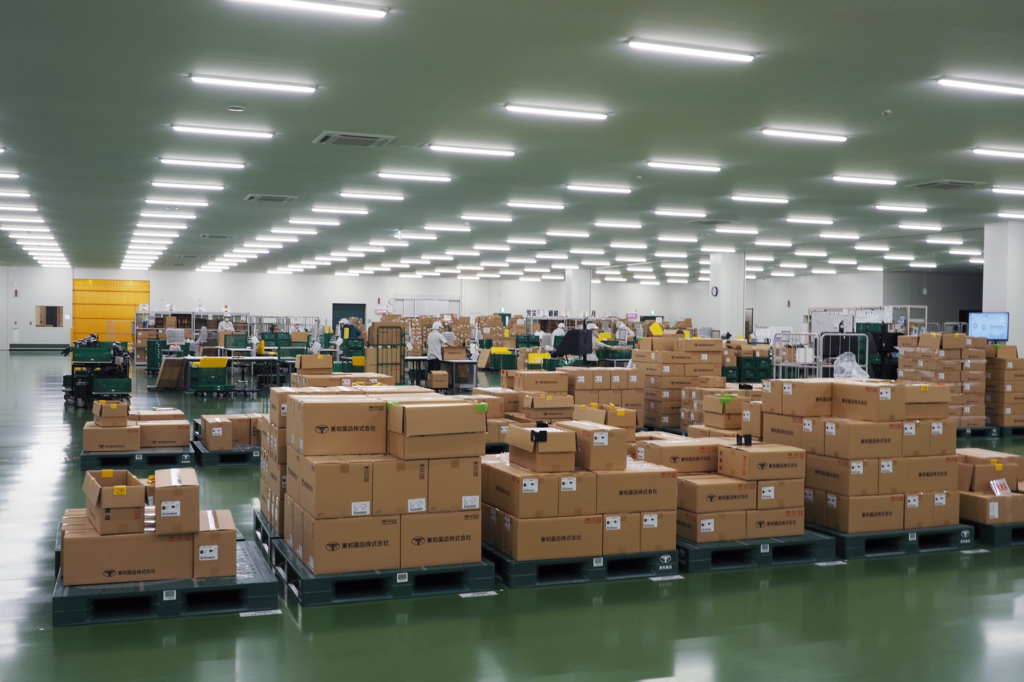
This center sits near Towa Pharmaceutical’s Yamagata plant and handles distribution for the eastern half of Japan, which makes it a critical node in the network. Drug shortages have pushed demand up, and in pharmaceutical distribution reliable supply is the overriding requirement. Against that backdrop the center was working on three things at once: reducing the physical load on its people, preparing for a shrinking regional labor pool, and keeping the operation running through emergencies. Live operation began in October 2024.
We asked the core project team how the PA-AMR XL actually runs inside a distribution center held to pharmaceutical standards. One of the more striking outcomes is what the deployment did to how the floor staff think about their own work.
Interviewed
- Yasuyuki Ito, Assistant Manager, East Japan Distribution Center, Logistics Division (title as of the March 2025 interview). Floor leader for the center.
- Hironori Wakimoto, Deputy General Manager, Logistics Division (title as of the March 2025 interview). Project manager with overall responsibility for the deployment.
- Kota Ikeda, Assistant Manager, IT Promotion Department, T Square Solutions Co., Ltd., the Towa Pharmaceutical group company providing healthcare IT services. Responsible for systems during the deployment.
Contents
- Why they started looking at automation
- The problem that triggered the evaluation
- Why they chose the PA-AMR XL
- What the pilot revealed
- A year of preparation and process change
- Internal reaction and what the floor built itself
- Productivity and labor impact
- Rapyuta’s support
- Where this goes next, and automation trends in pharma
- What makes a pharmaceutical warehouse a good fit for AMRs
Q. What do you handle at this center, and what is distinctive about the operation?
Ito: We handle generic pharmaceuticals. Depending on what the customer needs, we ship anything from the original case containing several dozen units down to a single package.
Pharmaceuticals carry strict standards in distribution, not only in manufacturing. Quality control here follows Japan’s Good Distribution Practice (GDP) guidelines for pharmaceutical distribution. Keeping the whole warehouse clean goes without saying, and on top of that we control temperature and we control against insects getting in from outside.
Inside the center we split storage into A, B, and C zones by each product’s shipping volume, and we use random-location slotting to get the most out of the space we have.
Q. What drove you to look at automation?
Wakimoto: Our business is forecast to grow, and at the same time the population projections for the Yamagata region show the working-age population shrinking. Even if every one of our current associates stays with us, the age profile of that group is going to shift over time. So raising productivity was necessary just to handle solid business growth with the workforce we have.
This also lines up with Japan’s national logistics policy guidelines, which call for automation and mechanization in response to the coming labor shortage. It was something we needed to take on seriously.
Q. What specifically triggered the evaluation?
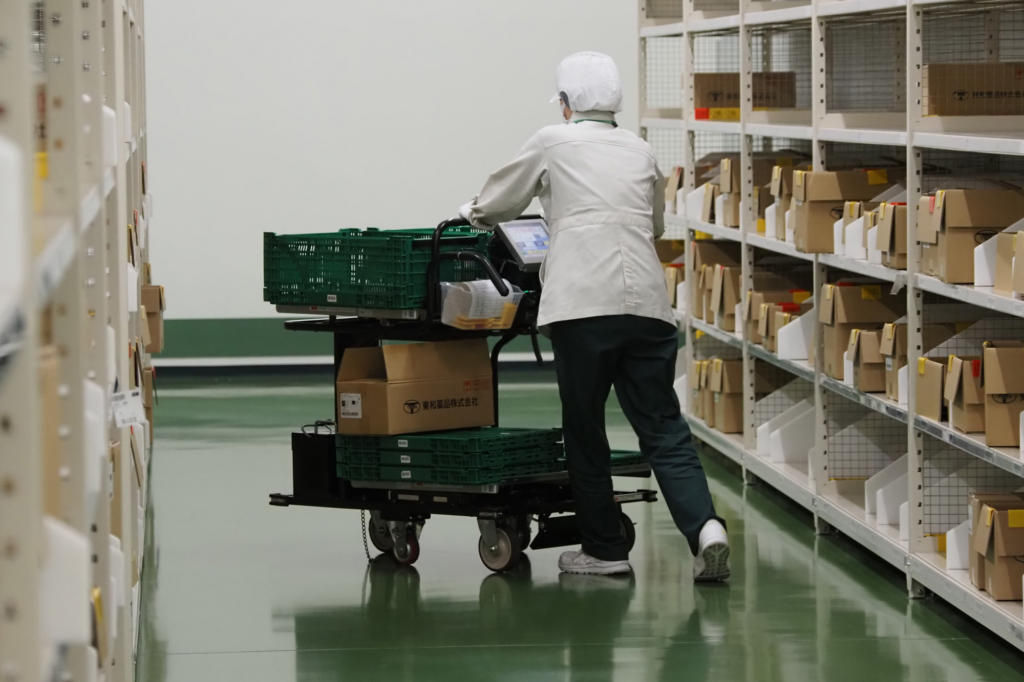
Wakimoto: The old picking method had people pushing a fairly large, heavy picking cart, working order by order in what amounted to one continuous loop through the center. Thinking about the physical load on our associates, we could see a ceiling on how much more productivity we could ask for. So we started looking at automation as one way out.
The first screening criterion was absolute. Shipping out of this center cannot stop, so any tool had to be something we could install and operate while continuing to ship pharmaceuticals.
That pushed us toward equipment that could raise productivity without major changes to our current WMS or our storage locations, and we landed on autonomous picking assistant robots working collaboratively with our people.
Something else came out of that research. Bringing in robots is not enough on its own. Standardizing the work so it is robot-friendly, and preparing the warehouse environment, matter just as much. At a seminar at the 2022 Kansai Logistics Expo, someone made the point that the goal is not to make people adapt to the robot but to build a robot-friendly environment. That stuck with me.
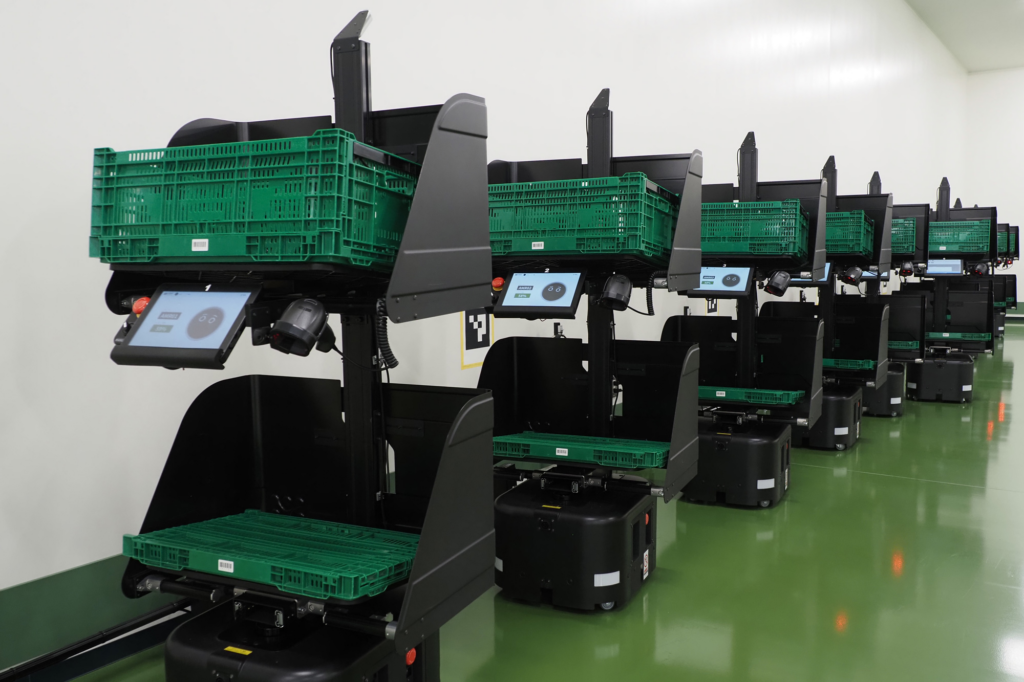
We looked at what we believe was every autonomous transport robot available in Japan at the time. We considered shelf-moving types, but we cannot change this center’s layout, so those were out. That brought us to pick-assist AMRs, and from there we compared in detail. What decided it was fleet-level traffic control with automatic rerouting to avoid congestion. That is why we selected Rapyuta’s AMR and moved into deployment.
Q. Why the PA-AMR XL specifically?
Wakimoto: The fleet control with automatic rerouting to avoid congestion, and the fact that an XL was in the lineup.
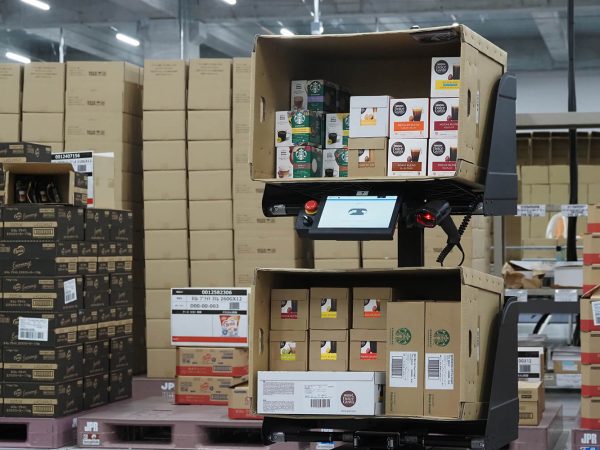
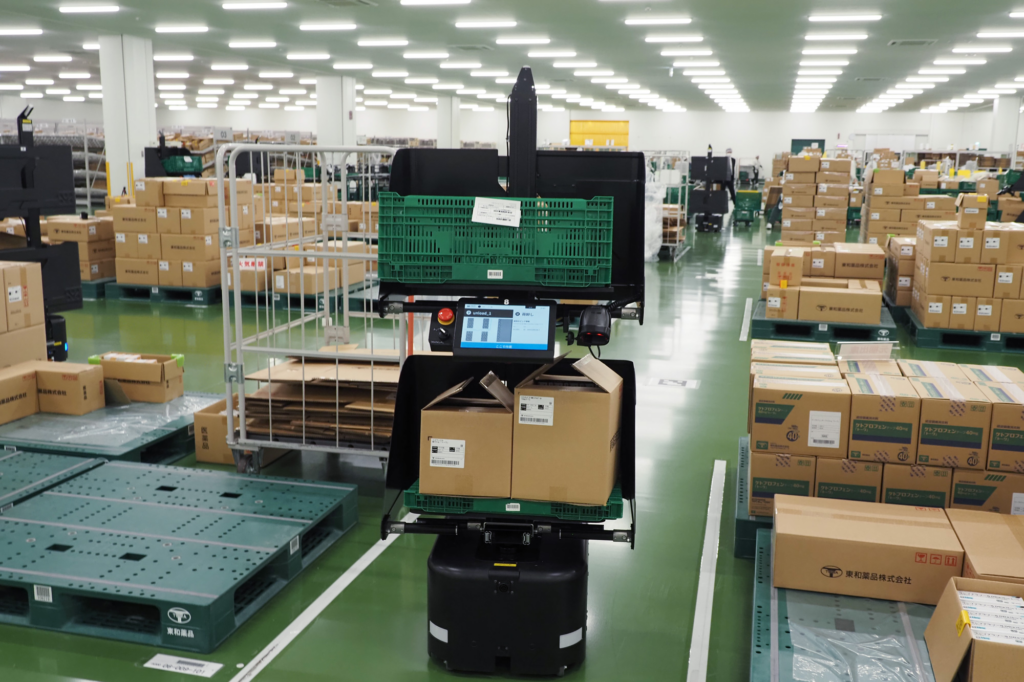
We needed the XL because this center does not only do piece picking. Some of the work is picking at the original shipping carton level, so we needed a robot that could carry the original carton itself, not a collapsible tote, and move it to the unload point.
Q. You ran a pilot before committing. How did it come out?
Ito: Honestly, the pilot did not deliver a large productivity gain. What it did confirm was that we could hold productivity at or above the old picking method.
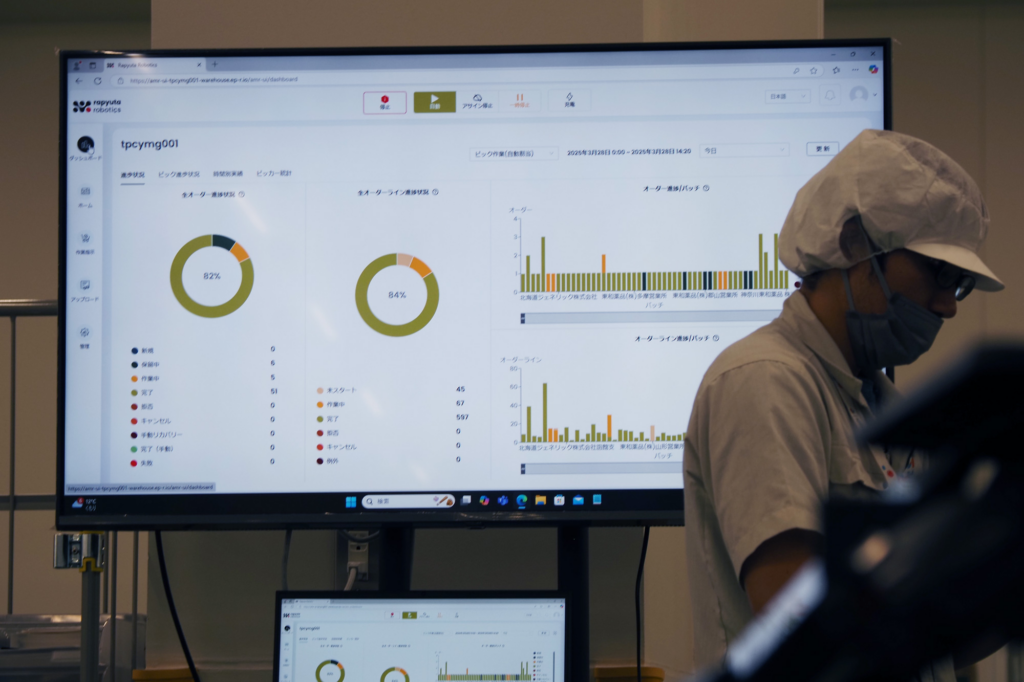
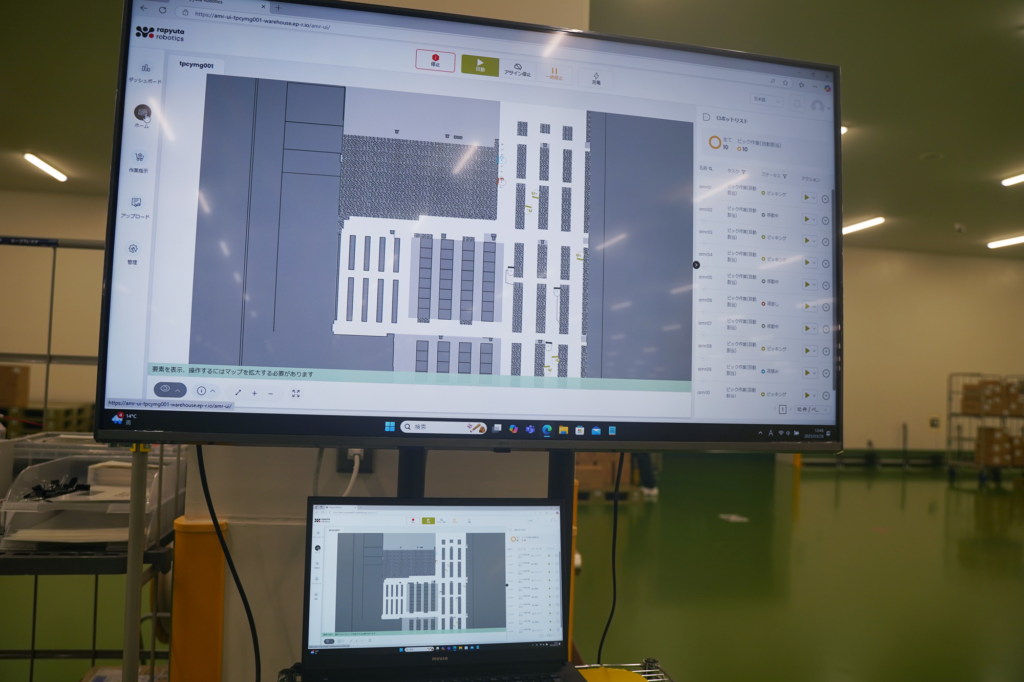
The bigger return had nothing to do with productivity. Using the robot data, we got real-time visibility into what was happening in the work.
The operator survey during the pilot also came back strongly on two points. Operators found the AMR picking process easy to learn and easy to teach to new team members, and a lot of them said the physical load was lighter. In a center with as many women working in it as ours, being freed from lifting and from pushing a heavy cart was a significant result.
We also saw real promise in two other areas: getting new employees productive faster by shortening training, and standardizing picking skill so that veteran and new associate alike produce at a consistent level.
There is still plenty of room to improve on productivity, but these byproducts, the things only a pilot would have surfaced, turned out to be worth a great deal.
Q. Was anything difficult about getting internal approval?
Ikeda: We started requirements definition in January 2023. Working through the various issues took time, so the pilot did not start until April 2024, which means the systems preparation alone took about a year.
The specific project problem was deciding and implementing how the AMRs and the WMS would exchange data. Our WMS not supporting API development had been a concern from the proposal stage. We looked at classic flat-file transfer over FTP as an alternative, and that turned out to be difficult too. In the end we built the integration API ourselves.
Moving from the pilot to the full contract raised a second issue: what happens during a system failure. The original proposal had every piece of equipment in a single configuration, which meant AMR picking would stop if the system went down. We could not call that stable operation. So we procured backup equipment, and Rapyuta worked out the detection and response flow with us, covering who does what when a failure happens.
In this deployment we kept manual cart picking available, so if something goes wrong we can recover by running carts. But as we automate further, building systems that stay available and do not stop the work during a failure is going to matter more, alongside the productivity and efficiency gains.
Q. Did you change any processes besides picking before go-live?
Ito: Some equipment cannot be moved because of how the building is built, so we had to fix the AMR load and unload areas in place. We reworked the inspection area layout specifically so that inspection and packing could flow smoothly after unload.
We also found that in the B zone, walking distances are short enough that manual single picking with the old cart is actually more productive. So the A and C zones became PA-AMR XL picking areas, and we run cart picking and AMR picking side by side. To make that work we revised the inspection and packing procedures and tightened them up.
On the hardware side, we asked Rapyuta to adjust the tray height on our PA-AMR XL units to make it easier to load the collapsible totes. The reason is that the share of women working here is very high, and reaching product into the upper shelf of an XL meant stretching quite a bit. Lowering that by about 6 inches (15 cm) contributed a fair amount to productivity.
Q. How did people inside the company react after go-live?
Ito: The advantage our staff had noticed during the pilot, that the picking with PA-AMRs is easy to learn and easy to teach to new members, came through strongly after go-live, especially in our busy months of March, April, and December.
Because the pilot had already confirmed that a new employee can produce at the same level as an experienced one, we put new hires on AMR picking and shifted our more skilled people to cart picking, which is the work that requires skill. That gave us efficient staffing and operation across the center as a whole.
Q. What has the floor built or adjusted since go-live?
Ito: We have made all kinds of floor-level adjustments to get more out of the operation.
First, we set up dedicated aisles to cut AMR travel time. With a picking cart, a person reads the aisle situation and moves freely. A robot cannot do that as easily. Rapyuta supported us here, and setting up separate AMR aisles cut travel time, which also shortened how far the operators move. The combined effect has been good.
Second, we have a place where empty cartons get opened and collected after picking, and we added more collection points for discarded cardboard to cut operator walking distance and smooth the flow of work.
Both of those cost us a little storage space, and both ended up as improvements.
The other thing we went after was the lost time when an AMR stops and restarts. If something gets left in a spot the robot treats as aisle, it stops, confirms it is safe, then goes around. That was adding up inside our travel time. So we defined fuzzy zones, meaning places where something might be sitting. Setting the environment up so the robot can move without stopping unnecessarily reduced that stopped time and shortened total travel time.
Alongside all of that, the inspection and packing efficiency work I mentioned earlier is something we keep adjusting even now that we are live.
Q. How does actual productivity compare to your pre-deployment simulation?
Ito: Compared with the simulation, we are currently running in only the A zone, the highest-frequency of our three zones, and we have not yet reached the productivity we originally expected.
We had planned to run A and C. But the distance between those zones meant the AMRs doing multi-order processing moved frequently, the pickers had to move with them, and the walking time reduction ended up limited. In our current setup it is hard to raise picking density, so we are focusing on the A zone and improving efficiency within it.
There was a second thing. Our associates were used to single picking, where you take the item and put it in the tote in front of you without thinking. When we tried multi-order picking with the AMRs, there was a moment of hesitation about whether the item goes in the upper tote or the lower one. That accumulated, and it showed up as a productivity loss.
After talking it through with Rapyuta, we dropped multi-order picking and went to one customer’s order per robot. Productivity started climbing from there. With few customers and high pick quantities, single was the better fit for this floor. The simulation was never going to catch that. We only saw it by running it.
Q. What was your first-year productivity target, and where are you now?
Ito: We set a first-year target of 99.0 lines per man-hour.
Our most recent figure is 76.1, and that is the A zone alone. So limited to the A zone, we assess productivity as 20% higher. That came from stacking measures: about 5% from the dedicated aisles, 5% from the cardboard measures, 5% from focus picking, and so on. Some of those measures work when volume is high and others when it is low, so it is a cycle of trial and error. The shape of the growth is an upward line with waves in it.
There is a structural point too. The big efficiency lever would be concentrating product in hot spots, but our random-location slotting makes that hard to operate, so we are running into limits that come from the warehouse itself. When product replenishes into whatever location is open, travel distance to it stretches out, and that is one reason productivity plateaus. It needs work.
Concretely, we are planning a trial that splits the fleet, dedicating something like 7 robots to the A zone and 3 to the C zone so each runs its own area, to attack the back-and-forth problem between them.
Q. How far along is the labor reduction you were targeting?
Ito: Not far, at this point. The reason is a good one: we are receiving a lot of orders, and inbound and outbound volume went up.
But even with a sudden increase in work, we have been able to staff it properly without running short of people, and that is a large effect for the center as a whole. We consider it necessary investment in meeting our responsibility as a company to supply pharmaceuticals reliably.
Wakimoto: We actually never led with labor reduction. Our thinking is not that automation lets us cut people. It is about facing a new technology, finding the efficiency in it, and working out how to apply the human capacity that frees up to the next problem, and to preparing for what comes after that.
As it turned out, shipping volume grew, the AMRs absorbed the added work well, and we are running comfortably with the same number of people as before. So the benefit we feel is much less about reducing headcount than about reducing effort.
Q. What support did you get from Rapyuta before and after deployment?
Ito: We got substantial support from Rapyuta’s customer success team on both sides of go-live. They ran a standing meeting on AMR operating efficiency and contributed to our productivity through results reporting and improvement proposals. They came out to this center many times with specific proposals, which we appreciated.
New functions have also arrived through software updates, and usability improved. Focus picking, a barcode skip function, and showing the next pick instruction while the operator is waiting have all gone over very well with the people on the floor.
Q. Overall, how would you rate the smoothness and the cost performance of the project?
Wakimoto: The deployment itself had system integration problems, productivity did not rise the way we wanted, and there have been small issues since go-live.
Fortunately we did not switch fully to AMRs, so when something went wrong we could fall back on the old method, and we avoided any situation where pharmaceutical shipping stopped. It would be hard to call the process smooth, but we took measures as we went, and looking back now I think it was within the acceptable range for a change of this size.
What I would say clearly is that since go-live, the regular updates addressing our issues and the depth of support from the customer success team make the cost performance feel very high.
Q. Where does your business and your wider logistics process go from here?
Wakimoto: We brought in AMRs aiming to raise productivity using what we already had, the existing facility, layout, and WMS. For productivity beyond this, I think we need to fundamentally revisit those legacy parts.
There are also things we only noticed because we actually deployed. What a friendly environment means for both associates and robots. What standardization means. What to watch for when automating without interrupting pharmaceutical supply. A lot of knowledge that only comes from operating. Solving for how to get the most out of AMRs is still only partway done, but I consider the decision to take this step an important one for the business.
We have also started thinking about which direction comes next. Do we keep pushing to get more out of AMRs, or are AMRs a bridge to something built on an entirely different concept? We are working that out day by day alongside the robots. Watching the pharmaceutical supply environment and how the Physical Internet develops, and thinking about coordination outside our own company as well as inside it, we need to draw a long-term picture and move toward it in planned stages.
Physical Internet, for readers unfamiliar with the term, is a concept borrowed from internet packet switching. Trucks share transport space and warehouses share storage and sorting space, which raises utilization of those logistics resources, moves the same freight on fewer trucks, cuts fuel consumption, and reduces greenhouse gas emissions in service of a sustainable society.
Q. What automation trends are you seeing in pharmaceuticals and medical devices?
Wakimoto: Japan’s Ministry of Economy, Trade and Industry has been convening a council on realizing the Physical Internet, and a roadmap has been drawn up targeting 2040. A pharmaceutical working group was launched as the fifth industry working group under that roadmap’s action plans, and it is discussing standardization and commercial practice. Medical devices are further along on standardization than pharmaceuticals, and I hear the discussion there is being driven by the major companies.
Going forward, and not only in pharmaceuticals and medical devices, I expect automation adoption to advance further across industries as they adapt to the social environment and to the Physical Internet.
Q. What concerns come up most often when pharmaceutical and medical device companies evaluate automation?
Wakimoto: Pharmaceuticals and medical devices are products connected to human life, and reliable supply is mandatory. So a distribution center has to have measures in place to keep shipping during trouble, including business continuity planning.
I mentioned the benefit of regular updates. From a Computerized System Validation standpoint, which is about verifying and confirming that something functions reliably, how you maintain assurance while accepting those updates is a significant question.
Ikeda: On the systems side, the key is building mechanisms and operating practices that keep equipment failures and system trouble from affecting shipping as much as possible. Securing availability in proportion to how much a given function affects the work, and building support around the business teams, both matter.
This is probably not unique to pharmaceuticals, but on WMS integration at deployment, plenty of APIs are available on one side while many companies’ WMS platforms are not yet able to work with them. It would help if other integration methods were better developed.
Q. Having been through it, what makes a pharmaceutical warehouse a good fit for AMRs?
Ito: AMRs get the most out of their flexibility in a warehouse that has to handle a range of shipping formats, original case level through individual package level.
And an environment where storage method is uniform, everything on floor-level storage, suits efficient AMR operation better than a warehouse like ours where the storage method differs by location.
Q. Any other advantages or drawbacks you have noticed in live operation?
Ito: Taking the first step into automation was itself the significant event. Because our floor associates got their hands on new technology, awareness of work efficiency went up again. Floor opinion matters enormously in driving efficiency, and when operators raise ideas themselves, that leads to further improvement in the workplace.
Wakimoto: During this project, a suggestion came up internally that people should go get the IT Passport certification. In this center the directly employed staff work with the AMRs every day, and I think that is exactly why a willingness to understand the digital side has taken root.
I have come to see that the labor savings automation brings are not a story about reducing the number of people working. Systems, tools, AMRs, they are all just implements, and whether productivity goes up depends on the person using them. But the experience of handling a new implement shifts how working people think, onto a new level. What matters in digital transformation really is the X, the transformation, and that may mean updating the people themselves.
Transform Your Picking Efficiency
Book a consultation with our solutions expert to see how Rapyuta PA-AMRs can improve your warehouse picking operations in real time.