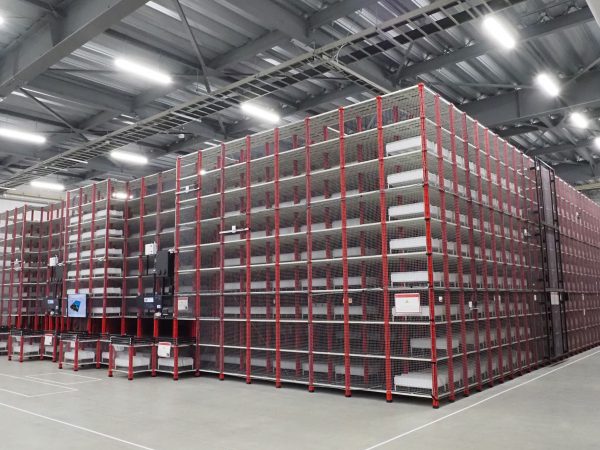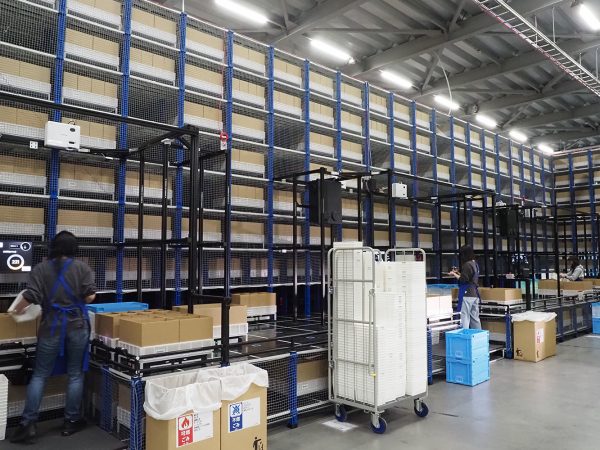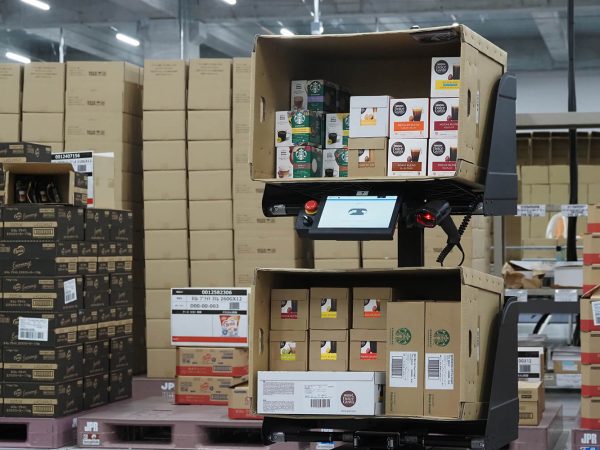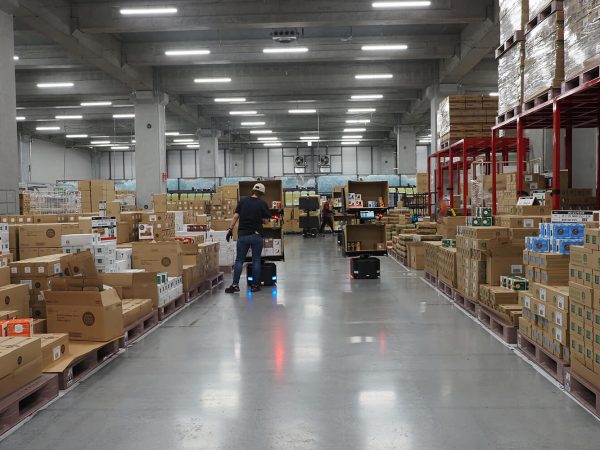
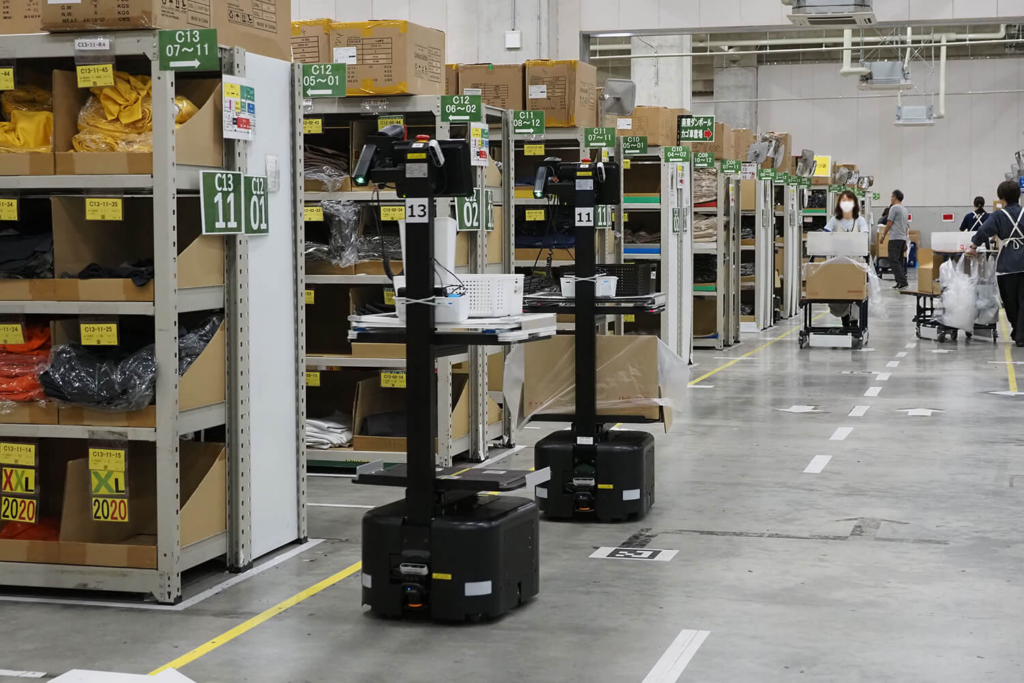
For operators looking at ways to cut picking labor, this is what an AMR deployment actually looks like on the floor. We interviewed the person who ran this project end to end, from vendor selection through daily operation, about what worked and what didn’t.
Summary
Six months after go-live, here is what the center has to show for it.
- Onboarding time collapsed. Bringing a short-term temp up to speed on manual picking took close to a full day. On AMR picking it takes about 30 minutes, and someone brand new is working independently within an hour.
- Walking is down by half. Associates on the longest pick paths covered up to 7.5 miles (12 km) a day behind a cart, and measured distance is roughly half that now. They also walk empty-handed, without a handheld terminal.
- The robots went into the building as it stood. No racking changes and no construction. The DC widened a few aisles a little at a time after shifts, which took about a week and never interrupted work for the client.
- Robots and carts share the same floor. The center chose to mix them rather than fence off an AMR zone, which extends the collaboration across the whole operation instead of one carved-out area.
- Owning the fleet gave them room to build on it. They mounted their own inspection table on the robots, added arrow lights to make robot position obvious, and can move units between sites as seasons shift.
Honda Logicom Co., Ltd., Kasugai Kozoji Distribution Center
| INDUSTRY 3PL | ROBOTS DEPLOYED 20 | LIVE SINCE May 2024 |
The site is Honda Logicom’s Kasugai Kozoji Distribution Center in Kasugai, Aichi Prefecture, Japan. It is a 3PL operation serving an apparel client, handling T-shirts, hooded sweatshirts, and similar goods. Picking here has always been manual and detail heavy. Every pick carries an inspection step, and the center ran the whole thing with associates pushing carts. As hiring got harder, staffing the floor to plan became a recurring problem.
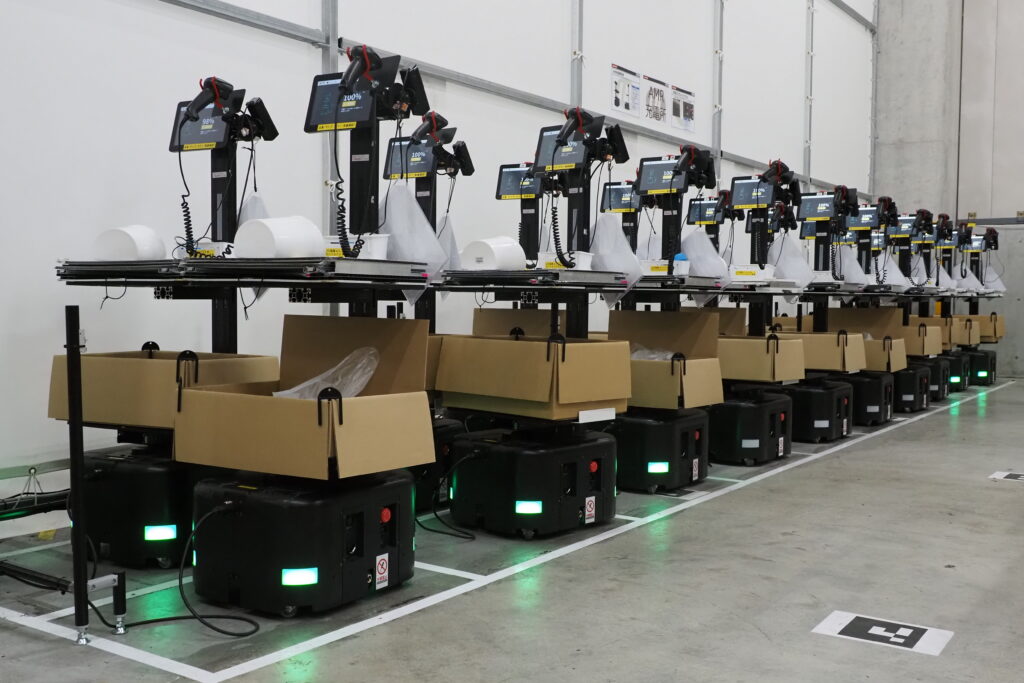
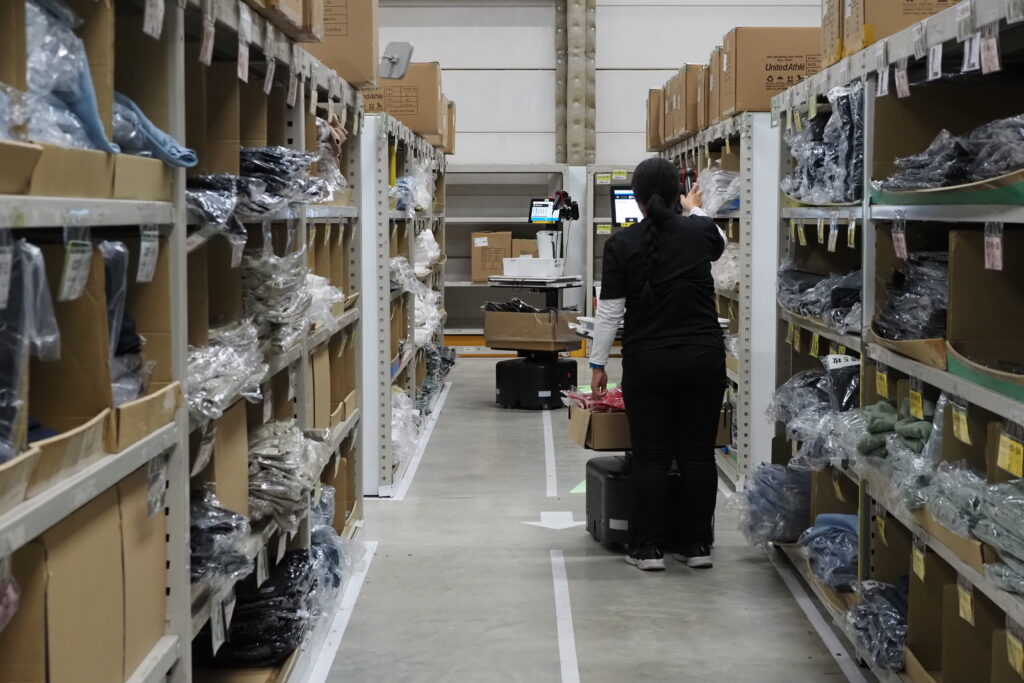
In May 2024 the center put 20 AMRs into a roughly 27,000 sq ft (2,500 m²) zone. The robots run mixed in with the existing cart picking rather than in a walled-off area, and the center adjusts who operates them depending on whether it is peak or slow season.
Interviewed: Tomoaki Nonogaki, Assistant Manager, Global Customer Service Department, Logistics Planning Division, Honda Logicom Co., Ltd.
Contents
- The facility
- Why they started looking at automation
- Why they chose Rapyuta PA-AMR
- Getting it approved internally
- Why they ran two pilots
- How the floor reacted
- Training
- Rapyuta’s support
- What they built themselves
- Productivity before and after
- Temp labor plus AMRs during peak
- What comes next for productivity
- Feature requests
- Expanding to other sites
- Three things that make a building a good fit for AMRs
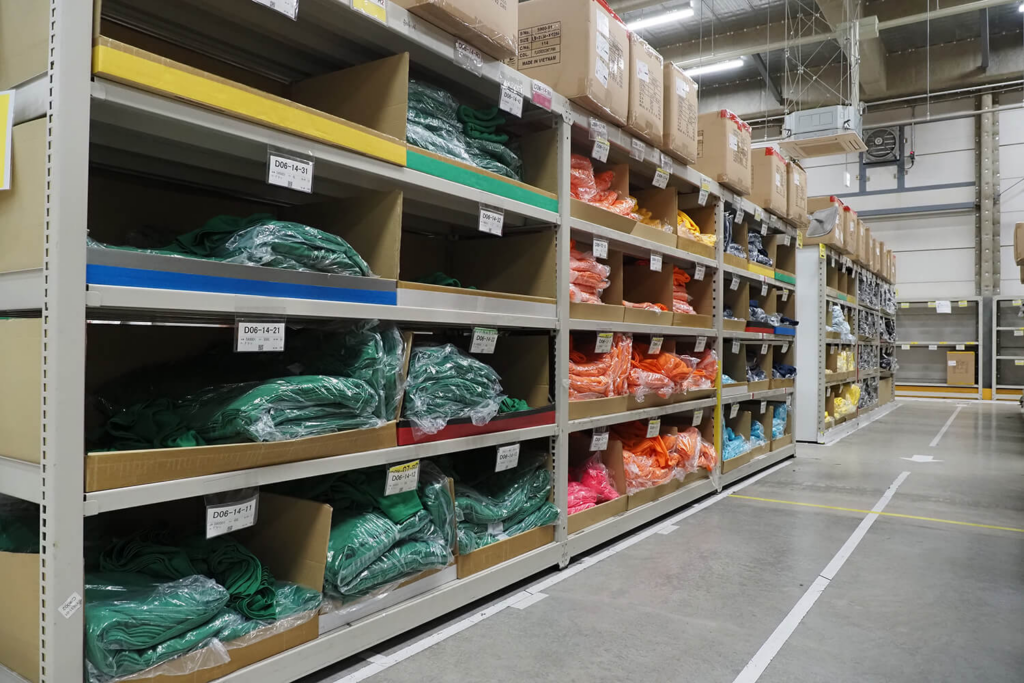
Q. What do you handle at this center, and how does the operation run?
Our client is an apparel wholesaler. T-shirts are the main item, plus hooded sweatshirts, tote bags, and caps. Until now, picking was fully manual. Associates pushed carts we built in-house, loaded one order at a time, and walked the full pick path to complete it.
Q. What drove you to look at automation, and what were you trying to fix?
We moved to this location from central Kasugai about seven and a half years ago. Our client’s assortment had grown, inventory grew with it, and the old building had run out of room. A large facility was going up in the Kozoji area at the right moment, so we relocated.
This area used to have a lot of people, since the Kozoji New Town development dates back decades, but the population has aged considerably. Even so, when we moved here seven and a half years ago, we had on-site childcare at the DC, which brought in a steady flow of applicants, mostly mothers with young children. Labor felt secure enough that automation was not a serious conversation.
Then several large distribution centers opened nearby, and it turned into a fight over the same labor pool. We started running job postings and not filling them. That eventually showed up where it hurts: missed delivery windows for our client. We recognized this as something we had to fix immediately, and at the same time we were looking at what the labor market does in ten or twenty years. About three years ago our president took direct ownership of it and we started working on logistics automation in earnest.
Q. What options did you evaluate?
Reducing picking labor was the urgent piece, so AMRs were the primary focus from the start.
We narrowed it to three AMR vendors, borrowed units from each, and ran them here in the DC to compare. We also ran test runs at another of our facilities that had been asking for automation for a while.
We had done our research online and seen machines at trade shows but running them on your own floor tells you far more. All three were well-built products. Before we understood anything about the functionality, our first impression of the Rapyuta PA-AMR was that the chassis was clean and well designed.
Q. What made you choose Rapyuta in the end?
With all three units actually running, Rapyuta’s moved most smoothly. Beyond that, we got hands-on with the machines and asked every vendor a lot of questions. Rapyuta answered the deployment questions, then went further with proposals for how we would raise productivity together after go-live. That forward-leaning posture came through.
When we buy material handling equipment, we weigh maintenance coverage and post-sale support heavily in the decision. The other vendors made their case, but Rapyuta’s support structure was more convincing. It felt like they intended to run alongside us. They were also very open to customization against the various requests we had. Seeing that attitude was a deciding factor.
There was another angle. A lot of small and mid-sized companies hesitate on automation investment, and we wanted to be first in Kasugai. We ended up choosing PA-AMR, which was already getting attention in the logistics industry here, and since going live, we have had a steady stream of companies asking to tour the site. We were thinking about that visibility and the business development it might generate before we ever signed.
Q. Was the internal approval process difficult?
Yes. This was where we struggled most.
Our pre-deployment simulation showed 20 robots as the fleet size that produced the best productivity gain. We modeled ROI on that, comparing a subscription against an outright purchase. When we put a dollar figure on what 20 robots would deliver, the subscription never turned positive, not even at twenty years. So, we bought it.
It was the right call long term, but it is not a small investment, and getting the company to approve it took work. We operate 29 facilities in Japan, and each center reports its own P&L monthly. The purchase price and the monthly maintenance cost both land in ours, so if the return is not there, Kozoji’s numbers just get worse every month. Estimating the payback period and explaining concretely how we would raise productivity after go-live, was the hard part.
We also had to answer, “There’s a better-suited building for AMRs, why start at Kozoji?” What settled it was that Kozoji had become our model center for customer tours, and our client here was unusually receptive to automation. That got us to internal consensus on going first at this site.
Q. What was the timeline from evaluation to go-live?
We ran two proofs of concept: three months from May to early July 2023, then a second from late August to early October 2023. We made the decision based on those results, and full deployment started in May 2024.
Q. Why two pilots instead of one?
My predecessor had set the load and unload points and the work sequence that the first pilot ran on. I took over just before that pilot, and once it was underway, it was clear the setup was somewhat off from what we actually wanted to achieve. I asked Rapyuta whether we could run a second one, and they said that was no problem.
Pilots cost money, so I needed internal approval. But because we were leaning toward purchase, the company’s position was that we should validate until we were satisfied. So, I made the case internally: the first run did not produce the results we expected, and I want to run a second one set up to overcome those issues. The answer was that if it was for validation, go ahead. That is how the second pilot happened.
I also wanted the confidence of being able to say, “here are the numbers the trial produced,” as ammunition for the final approval. The second pilot did produce reasonably good numbers, so I could add a positive story to the case, that there was real headroom above this.
Running two pilots left us with clear target numbers, and full deployment went smoothly as a result.
Q. How much did you have to change your operation or your layout?
One of the reasons we picked the Rapyuta PA-AMR was that we could deploy it into the existing layout without stopping work on the floor. Being able to do it without disrupting our client is a big deal for us.
That said, the layout had been designed around cart picking, so we made small adjustments, widening some aisles a bit so carts and robots could pass each other. We did that a little at a time after each shift, and it took about a week. Not a significant change.
Q. How did the floor take it? What did associates say?
The first time they encountered the robots, I think there was a mild allergic reaction to the machines. Mostly it was, “it moves on its own and comes toward me, it’s a little scary.” To work through that, we set the pilot at about three months and ran it live on the floor.
Early on, everyone would stop what they were doing whenever a robot approached. That actually slowed work down. They were not used to it, so they froze. And because it was a trial, there was a strong sense of “we’re borrowing something expensive.” Some associates figured breaking one would be a disaster, which made the robots feel unapproachable.
Within a month, though, people had adjusted, and they would walk past a moving robot without thinking about it. There was also an initial concern in some quarters that the robots were there to replace people. A temp associate asked me directly, “Is my job going away?” As the idea of working with the robots spread, that fell away almost entirely.
At one point we considered separating AMR picking from manual cart picking into distinct zones. Given our space constraints, we could not find any advantage to separating them in this building. So we run both mixed together on the same floor. The core benefit of an AMR is that a person and a robot collaborate on one task. Our thinking now is to extend that idea outward: cross the robot work with the traditional manual picking so multiple work streams collaborate at the scale of the whole center.
Q. How did you train the floor?
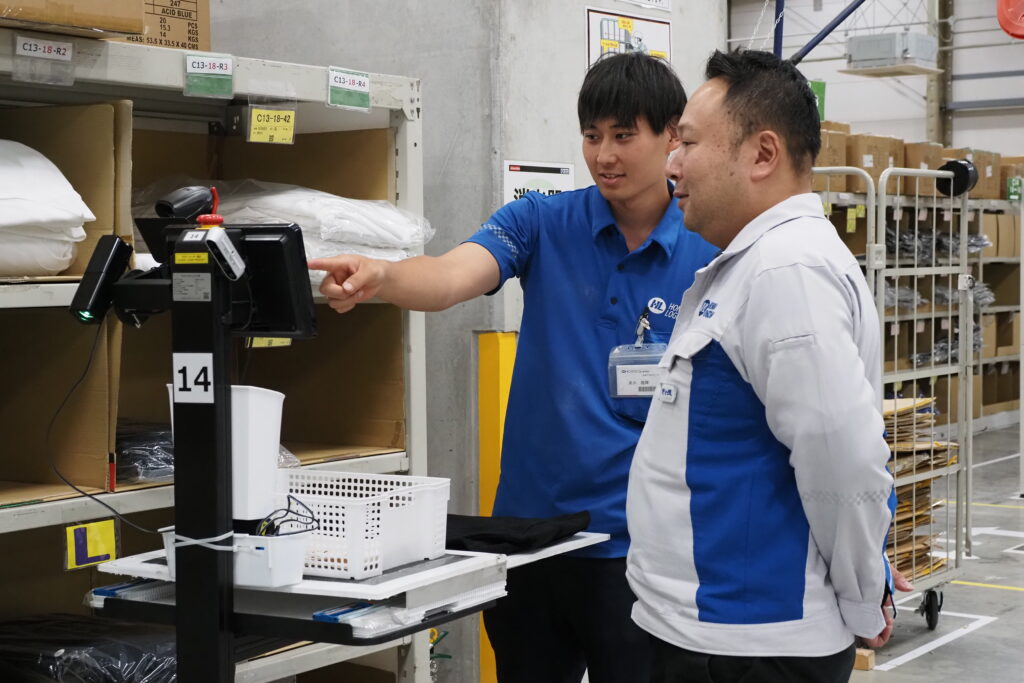
From the trial onward, we rotated every associate through, using the robots daily. The point was to get them fluent with the controls. The operation itself is simple, so “getting comfortable through exposure” is probably a more accurate description than “training.”
What happened was that everyone who worked with a robot started saying, “these are great.” They told us in pieces: they did not want to go back to pushing a heavy cart, the touchscreen was easy to use. Things you only understand by doing them.
Most of our associates here are women, and the ones covering the longest pick paths were walking up to 7.5 miles (12 km) a day pushing a cart. After the AMRs went in, measured walking distance was cut roughly in half. They could feel the difference in fatigue.
I had picked during the pilot myself, so I already knew how much lighter each task felt, and I was confident the floor would recognize the benefit. The response was better than I expected.
One more thing came up. With cart picking, you carry a handheld terminal in your hand to verify. With the AMR you walk empty-handed, and several people said that alone made a real difference. Carrying a small device is nothing on its own, but over a full shift it adds up into a genuine burden. That was a discovery for us.
Q. Did the WMS integration go smoothly?
No major issues on either the trial or the full deployment. It slipped a little on our side, but Rapyuta’s systems lead and ours worked together, and it went relatively smoothly.
Q. What did you build or modify yourselves once you were live?
The AMRs run very quietly, but the warehouse is full of the constant clatter of manual picking carts. That made it hard for associates to notice a robot approaching, and we had situations where a cart and a robot nearly collided. We wanted that fixed fast for safety reasons, so we added green arrow-shaped lights of our own design to make robot position more obvious.
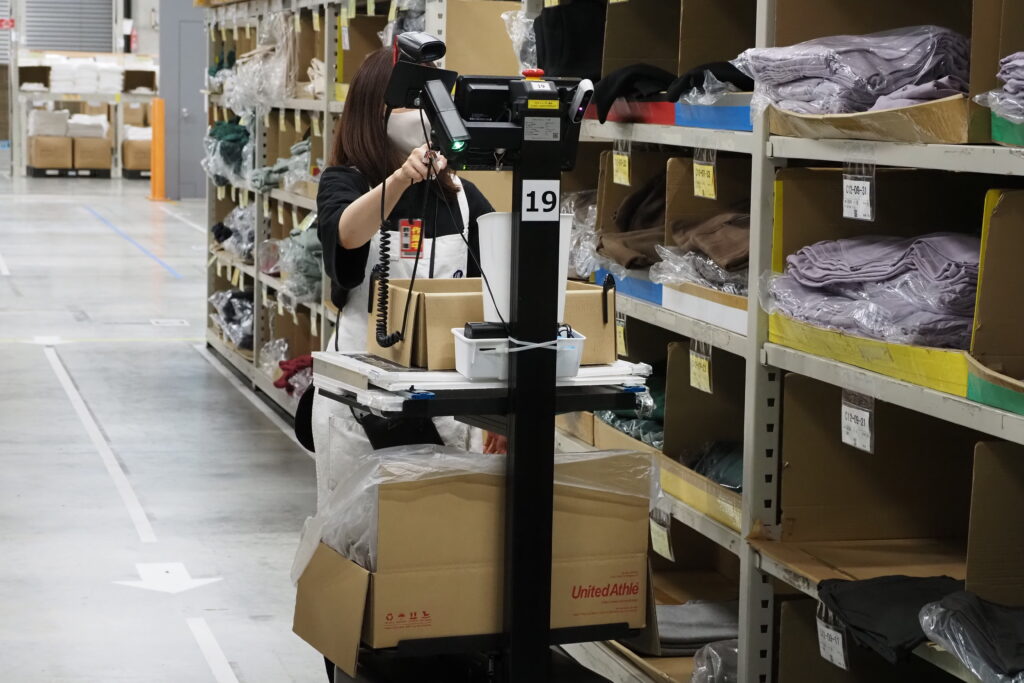
We also customized the chassis. The goods we handle here do not carry barcodes on the item. To verify, associates scan the barcode on the shelf location itself. That means inspection has to happen at the same time as the pick, so we built and mounted our own inspection work surface on the robot. That is the kind of original modification you can probably only do when you own the machines.
Travel speed took some tuning too. In an empty aisle the robot runs at its configured top speed, a little faster than a normal walking pace and a little slower than a brisk walk. Even at that speed we had a few near-misses at blind corners. So we walked the building with Rapyuta, identified the risky spots, and had them configure mandatory stop points and reduced-speed zones in the software.
Q. What kind of support have you gotten from Rapyuta?
Before go-live and immediately after, we held weekly meetings and worked issues closely. Now that we are running stable it is every two weeks, but they have made clear that if something comes up and we want weekly again, they will do it. That matters.
On response speed, anything the account team could resolve themselves came back very quickly. When we call the support desk they connect us straight into Rapyuta, so no complaints there. On post-go-live productivity, their customer success lead is running alongside us. Having Rapyuta lean into solving problems with us is something we appreciate.
I may be a demanding customer, but on the harder requests, responses sometimes took longer than I would have liked, and there were times I asked them to share status along the way. That said, I am well aware we have asked for last-minute changes. Because I am the single point of contact for AMR operations on our side, every answer from Rapyuta and from inside our company funnels through me, and there were stretches where I was the bottleneck.
Working through that is exactly why the trust is deeper now. We are looking at the same goals, and we are getting to a place where both sides can say what they think. Rapyuta will tell us plainly and without hedging, “here’s why this is the result you’re seeing,” and that often turns into something we learn from.
Q. How does actual productivity compare to your pre-deployment simulation?
Six months in, productivity is climbing gradually, but we have not hit our initial target yet, so we are on the floor every day looking for anything we can improve. Some of the gaps are on us. On productivity specifically, there is a lot still ahead of us.
We can see the path to it, though. May through October, the period since the AMRs went live, is our client’s peak season, and the people running AMR picking were short-term day-hire temps. My read is that the real productivity gains come in the slow season, when permanent staff are operating the robots. Even so, we are running about 10% faster overall than we were with carts only. Early days, but the effect is already there.
The bigger effect is how little training the robots require. With manual picking, bringing on a short-term temp took close to a full day of training. With AMR picking, a fast learner has the whole sequence down in about 30 minutes at a level where shipping is not affected. For staffing the floor, that is enormous.
So the stage we are in right now is less about hitting the productivity number and more about running to what the floor needs. Chasing the productivity target in earnest is genuinely still ahead of us.
Q. How much of the year is peak, where you’re bringing in temps?
Peak runs from May through the end of October every year, and we generally staff up with day-hire temps.
As I mentioned, this area is hard enough for conventional temp staffing. But with day-hire temps, a lot of people can work around gaps in their week: available today only, or Tuesdays and Thursdays only. During peak they have been a real help. Even with someone brand new, 30 minutes to an hour and they are working independently. The training time savings are worth a lot operationally.
We have established that day-hire temps plus AMRs deliver reliable performance during peak. The next thing to work out is how efficiently permanent staff plus AMRs can run once we are into the slow season. That is what ties directly to year-round labor efficiency and cost reduction.
Q. Concretely, what do you need to do to raise productivity from here?
First is having permanent people operating the robots.
Outside of peak, when temps are in the building, if the person running the AMR changes every day, you are constantly teaching the fine points of the work to someone unfamiliar with it.
Take our operation: picking here includes inspection. What you verify visually is item number, size, and color. Under dim lighting, some people will call navy black. These are garments, so there are per-item rules for how they are folded and how they are packed into cartons. There is a lot of detail layered on top of the pick itself.
With that many rules, you cannot absorb them in a short stint. To master every step well enough to run the whole thing alone, I would estimate about a month.
Our assumption is that productivity only starts to bend upward once you have people trained to that master level operating the robots, and that is exactly what we are aiming at in the coming slow season.
In fact, during the second pilot we saw more than double the productivity under that kind of operating model, so we are confident about getting to roughly 200% of our baseline. We already expect we can revise that up by another 20% or so from there.
Q. Overall, how would you rate the smoothness and the cost performance of the project?
Because raising productivity is still part of the goal, I would call it about 70% right now. The remaining 30% is the target we have not hit yet.
On the deployment itself, we are broadly satisfied. On smoothness, they took on a range of requests from us and delivered on schedule. They ran a standing weekly meeting and gave us results through the prior week, plus advice and improvement ideas.
We are about to make some changes to the robot configuration, and their engineers were here again this week. Even for things that could be handled on a video call, they make the trip to see the issue and the reason for it with their own eyes. That takes a lot of our anxiety out of it.
Q. What would you like to see from the AMRs going forward?
At a detailed level, I would like the barcode scanner to be cordless. With other apparel operations the barcode is on the item, so a tethered scanner works fine, because you bring the item to the associate. Here, there is no barcode on the goods, so we scan the barcode on the rack holding them. When that is above the reach of the cord, it is awkward. A cordless scanner is a feature I would really like to see.
Even more granular: I would like to be able to customize the display settings on the screen ourselves, things like placement and text size. For example, when we are putting items into a two-tier tote, we make the upper destination green and the lower one blue. Then when we train someone, we can just say “green” or “blue.”
Q. Are you considering expanding to other sites?
Both adding robots here and a new deployment at another center are already on the internal agenda, and the data so far has been shared internally. When we first looked at automation, this center and the one we are now considering were the two finalists.
That site houses the DC for a dental materials company. Every item carries a barcode, and because they ship direct to dental practices, orders are small and numerous. If you want to use everything an AMR is good at, the need there is strong. The work area is tight, though, so we are evaluating sorters and other automation alongside AMRs, and it is genuinely unclear which way it goes.
There is also an idea floating internally about moving, say, 10 of the 20 robots here over to that site during our slow season. It is hypothetical for now, since we have expansion plans here too, but that kind of flexibility is only available because we bought the robots rather than subscribing.
Q. Having been through it, what makes a building a good fit for AMRs?
From what I have seen: a floor without unevenness, wide aisles, and barcodes on the items.
On operating profile, small-parcel is the fit. AMR picking suits B2C flows like e-commerce fulfillment centers. And given the order data integration, I would treat having a WMS already in place as a hard requirement.
Transform Your Warehouse Efficiency
Discover how Rapyuta PA-AMRs can revolutionize your warehouse picking operations