Introduction
In high-volume distribution centers, where thousands of individual items are picked and packed daily, accuracy isn’t just a KPI — it’s the backbone of profitability. Yet, one of the most persistent and underestimated challenges remains miss-picks during piece picking operations.
A single wrong item, color, or SKU can set off a chain reaction: returns, reshipping, rework, and customer dissatisfaction. While these may seem like small, isolated errors, their cumulative impact can quietly drain operational margins and productivity.
The Real Cost of Inaccuracy
According to the National Retail Federation (NRF), U.S. retailers processed $743 billion worth of returns in 2023, representing 14.5% of total retail sales. Within e-commerce, where order volumes are fragmented into thousands of individual picks per day, return rates average 17–20%, and a significant portion of these are linked to fulfillment inaccuracies such as wrong item, size, or color.
For piece-picking operations, each miss-pick doesn’t just mean an extra shipment — it often involves:
- Additional labor to locate, repack, and reprocess the returned item.
- Reshipping costs that double the logistics effort for a single order.
- Customer service time to resolve complaints or refund requests.
- Loss of customer trust, which directly impacts repeat business.
Even a 0.5% miss-pick rate in a large distribution center handling tens of thousands of daily orders can lead to substantial hidden losses, both financially and operationally.
A Ground-Level Reality
Imagine a picker fulfilling an online order for a phone case – model, color, and size specific. What happens more often on the warehouse floor is something subtler: the wrong quantity being picked, or an item meant for one order getting placed into the wrong container when a picker is handling multiple orders in parallel.
The order ships with that small mistake unnoticed. A few days later, the customer requests a return because something is off, too many items, too few, or the wrong item in the package.
By the time the correct product reaches the customer, the warehouse has absorbed two-way shipping, labor for rework, and customer-service handling time. For the customer, the inconvenience often reduces the likelihood of a repeat purchase. For the warehouse, it becomes another small dent in profitability that rarely surfaces in headline metrics.
Why Warehouse Leaders Should Care
In distribution centers where piece picking makes up a major share of labor activity, even a minor error rate can have significant cost implications. Many warehouses run separate quality-validation routines where each item is scanned before packaging. These QA checks often consume as much time and labor as picking itself, and any pick-quality issues discovered at this stage introduce rework, slow down workflows, and delay delivery.
Beyond the immediate costs, these delays strain staff, impact service-level agreements (SLAs), and ultimately affect customer satisfaction — the most critical measure of fulfillment performance.
The Real Sources of Miss-Picks: A Systems-Level Look at How Errors Form in Piece Picking
Inside most distribution centers, piece picking is where accuracy is won or lost. This is the stage where individual items are picked — sometimes thousands per shift — and each small decision made by a picker determines whether an order is fulfilled correctly.
Even with mature Warehouse Management Systems (WMS), barcode scanners, and SOPs, miss-picks remain one of the most common causes of avoidable cost in fulfillment. They don’t happen because people don’t care — they happen because of how the process is structured, pressured, and scaled.
In most facilities, piece-picking is done either as:
- An integrated workflow — where pickers handle piece orders alongside cases and pallets, or
- A separate stream — dedicated to e-commerce or smaller high-SKU orders.
Let’s look at how miss-picks occur across the most common picking methods and why even the most experienced teams can struggle with them.
A. Manual or Cart-Based Picking
Manual picking is still the dominant approach in many mid-sized and legacy distribution centers, relies on human pickers walking long aisles with a cart, guided by printed lists or handheld scanners.
It’s flexible, simple, and cost-effective to set up. But it also has the highest potential for human error, especially as SKU counts and order volumes grow.
Typical ground-level realities:
- Visual confusion: Two SKUs look identical – same packaging, slightly different size or color. In the rush to meet pick targets, the picker selects the wrong item.
- Slot inconsistencies: Replenishment teams sometimes place items in the wrong bin, but the WMS still shows the original location. The picker trusts the system and pulls from the wrong slot.
- Fatigue factor: In an 8–10 hour shift, a picker might walk 10–15 km. Towards the end of the day, focus drops, and so does accuracy.
- Batch-pick mix-ups: When picking multiple orders on the same cart, items occasionally end up in the wrong tote, small errors that are hard to catch before shipping.
- Counting complexity: Many mis-picks stem from counting errors. For example, if a picker needs 246 units and the item is available as subpacks of 3, packs of 18, and cases of 90, the picker must manually compute the optimal combination and count correctly.
- Under time pressure, these multi-pack calculations often lead to incorrect quantities being picked.
Even with scanners, the verification step often becomes “autopilot” when the workload is heavy. Over time, this makes manual picking one of the most error-prone fulfillment models – especially during peak season.
B. Pick-to-Light and Voice Picking Systems
Pick-to-light and voice-picking systems were introduced to reduce walking time and visual dependency. Lights indicate where to pick, or voice prompts guide the picker through each step.
These systems boost speed and can cut error rates by 30–50% compared to manual picking, but they still depend on consistent human execution.
Common challenges in practice:
- Environmental issues: In brightly lit or noisy warehouses, light indicators or audio prompts can be missed or misunderstood.
- System lag: When the WMS updates slower than real-time replenishment, the indicator may guide the picker to an empty or incorrect bin.
- Cognitive overload: Pickers handle multiple cues — lights, voices, scanners, tote placements — and under time pressure, one missed confirmation can cascade into a mis-pick.
Pick-to-light systems are excellent for high-throughput operations, but without tight process discipline and calibration, they can still introduce small but costly errors — particularly during rapid SKU changes or promotions.
C. Automated Storage and Retrieval Systems (ASRS)
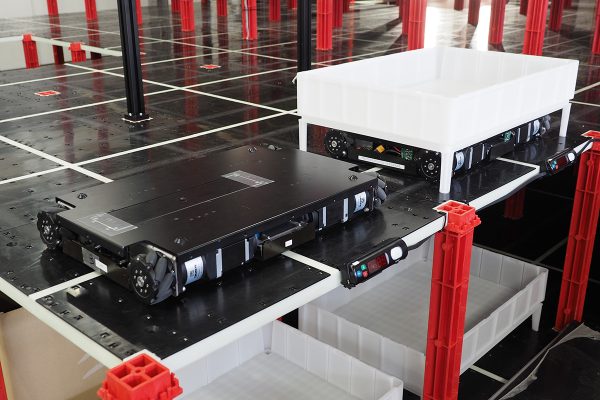
ASRS automates the “goods-to-person” flow by bringing bins or trays to a fixed workstation. This drastically cuts travel time and allows operators to pick more efficiently.
However, ASRS is typically optimized for medium to high-volume SKUs with stable demand — not the fast-moving, variable product mixes found in e-commerce fulfillment.
Where miss-picks still happen:
- Data mismatches: The system may call the wrong bin if inventory records are off, leading the operator to confirm a wrong item without realizing it.
- Transfer errors: When the item moves from ASRS to the manual packing area, human operators might misplace or swap items between bins.
- Maintenance or system downtime: When ASRS units are offline or recalibrating, teams often revert to manual retrieval — a mode switch that can spike temporary error rates.
ASRS is powerful but rigid; it shines in repetitive SKU environments but struggles with constant assortment changes that characterize modern distribution.
D. Pick-Assist Autonomous Mobile Robots (PA-AMRs)
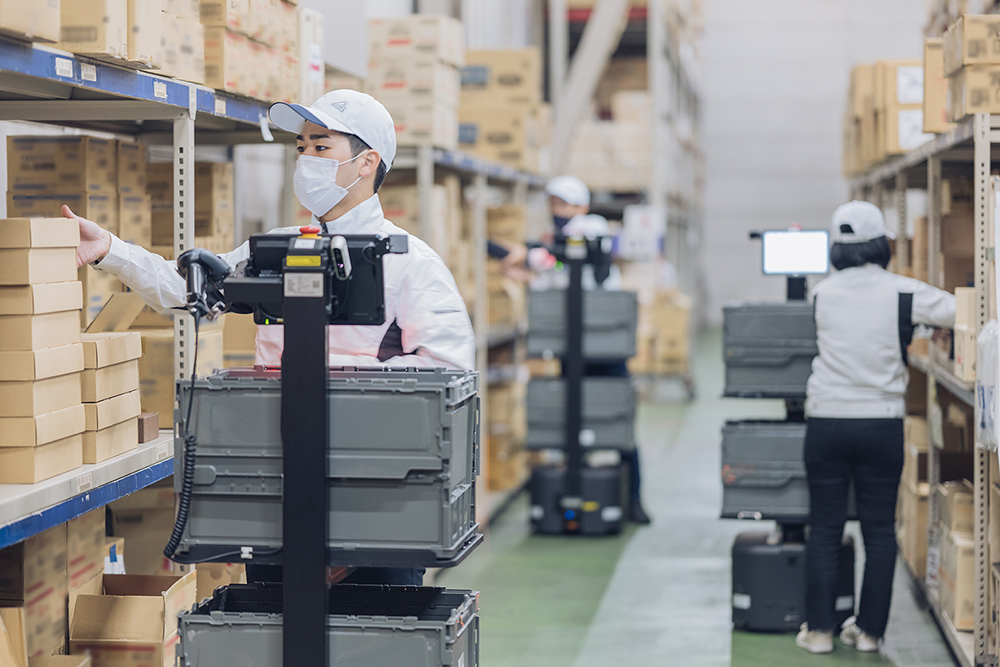
PA-AMRs represent a new phase in warehouse accuracy — combining human intelligence with robotic precision. Instead of workers walking to products, robots travel to pickers, guiding them through optimized routes and validating every pick digitally.
Unlike traditional automation, PA-AMRs are flexible and scalable. They don’t require a full facility redesign, and they integrate smoothly into existing WMS systems.
How they minimize miss-picks on the ground:
- Real-time confirmation: Robots sync instantly with WMS to display correct SKUs and quantities before each pick.
- Reduced fatigue: Since pickers no longer walk long distances, their focus remains high throughout the shift.
- System-guided accuracy: Barcode or vision verification ensures that every item picked matches the order.
- Adaptive learning: Some systems analyze historical errors and suggest improvements in slotting or pick paths to reduce repetition.
Pick-assist robots don’t replace workers — they enable them to perform at a higher level of consistency. Facilities that have adopted PA-AMRs often report significant drops in picking errors and sharp improvements in throughput, without sacrificing flexibility.
How Rapyuta PA-AMRs Redefine Error Prevention: Passive, Active, and the Next Leap with Weight Inspection
Modern fulfillment environments operate at error tolerances measured in basis points. In piece picking, the industry benchmark is just 0.03%—a target that traditional barcode workflows struggle to sustain at scale. Achieving this level of precision requires automation designed not only for throughput, but also for continuous, system-level error prevention.
Rapyuta Pick Assist AMRs (PA-AMRs) integrate passive, active, and now weight-based verification to deliver a closed-loop picking workflow with near-real-time accuracy assurance.
1. Passive Feedback: Structured Operator Guidance
Passive feedback provides cognitive support to the operator, reinforcing correct actions through visual or interactive cues. This reduces confusion and accelerates onboarding, though minor confirmation steps may slow the process slightly.
Examples
- Put-To-Light LEDs: Put-To-Light LEDs are arranged as LED bars located at the bottom of the tray. These LEDs activate in different patterns – partial blinking, full blinking, or steady indications, depending on the stage of the workflow. Each pattern serves as a passive signal that naturally draws the operator’s attention to the correct tote.
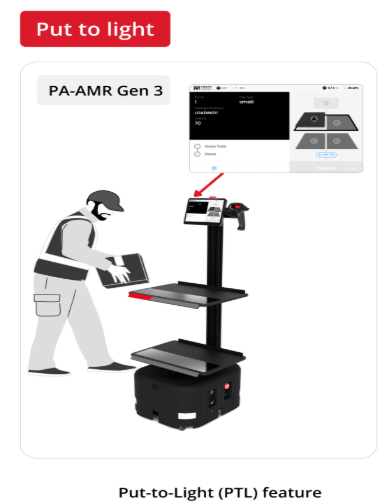
- During Load: The LEDs blink exactly at the location where the tote must be placed. The operator simply aligns the tote with the blinking section, reducing the chance of loading it in the wrong position.
- During Pick: The LEDs blink underneath the tote designated for the current items. This ensures the operator intuitively knows where each picked SKU should go, avoiding cross-tote errors.
- During Unload: The LEDs blink under the tote that needs to be removed from the tray. This prevents unloading the wrong tote and helps maintain flow during batch consolidation or outbound processing.
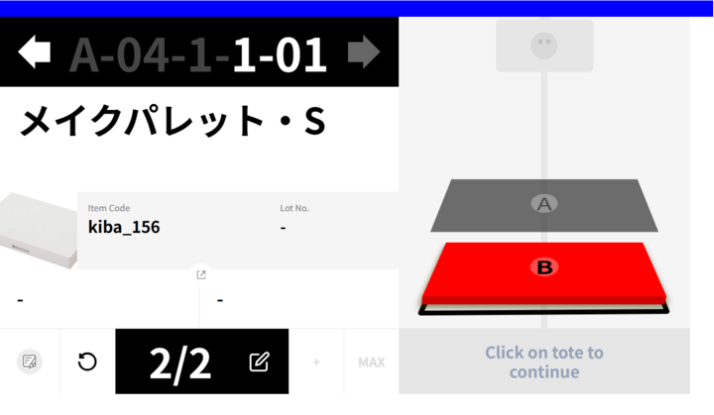
2. Tote Confirmation via UI Tap: A simple tap on the UI (“Click Tote”) confirms that the scanned tote has been placed in the correct tray position. It reinforces correct loading without interrupting workflow.
- Workflow
- Scan a registered tote of the tote type shown on the UI.
- Place the tote in the designated tray position highlighted on the RUI and PTL LEDs.
- Tap the tote icon on the UI to confirm the placement.
- Error Handling



3. Color-codes and UI elements: Put-to-Light LED colors can be configured to match the tote color shown on the RUI, creating a consistent visual link between the tray, tote, and UI. This is important to reduce cross-tote confusion.
- Workflow
- RUI displays the expected tote color for the current step.
- PTL LEDs illuminate in the same color at the correct tray position.
- Operator matches the physical tote color with the LED and UI cue to place it correctly.
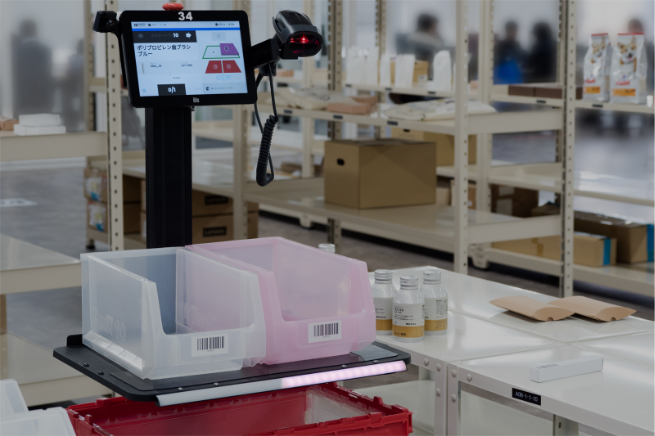
4. Post-pick summaries: A summary screen showing key details of the pick quantity, tote color, and tote position. It gives operators a quick chance to verify the action before final confirmation.
- Workflow
- Complete the pick and place the item into the highlighted tote.
- UI displays a summary of the picked order (quantity, tote color, tote position).
- The operator reviews and confirms or corrects the action if something looks wrong.
How Rapyuta PA-AMR’s Passive Error Elimination Methods Help Pickers & Operational Accuracy
- Lower error rates driven by operator-initiated confirmations (tap, visual check), without adding training burden.
- A faster ramp-up for new and seasonal staff due to clear, passive visual guidance.
- Reduced cognitive variability because operators rely on consistent cues rather than judgment or memory.
- More uniform picking and loading behavior across shifts, improving process stability.
- Fewer downstream corrections since operators catch mistakes before confirmation.
- Higher overall throughput as operators stay aligned with system expectations with minimal intervention.
2. Active Feedback: Automated Real-Time Error Detection
Active feedback shifts the verification burden from the operator to the system. Errors are detected and surfaced immediately, with no added steps during normal operation.
Examples
- Instant mismatch alerts for SKU, quantity, or tote errors.
- Workflow blocks until the operator corrects the issue.
Value for Operations Leaders
- Zero productivity loss during error-free picks.
- Significantly reduced reliance on downstream audits.
- Higher throughput stability during peak season operations.
Active Feedback – The New Standard: Real-Time Weight Inspection
Weight inspection elevates active verification by embedding sensor-driven, real-time validation directly into the pick. High-precision load cells under each tray continuously analyze weight changes as items are placed.
How It Works
- Real-time measurement of weight deltas as items enter the tote.
- Error blocking within ~1 seconds when detected weight does not match expectations.
- Hands-free verification unless anomalies occur.
Why Weight Inspection Is a True Active System
- Autonomous validation runs in the background.
- Immediate surfacing of mismatches before they propagate across the batch.
- Operator involvement only when corrective action is required.
Accuracy Advantages
- Consistently supports 0.03% accuracy benchmarks even in high-speed workflows.
- Batch-level verification replaces slow, item-level scanning.
- Dual-scale configurations detect misplacements between upper/lower or left/right trays.
- Coverage across overages, shortages, misplacements, overloads, and subtle weight variances.
Error Types and Detection
Weight inspection extends accuracy by actively detecting and classifying multiple error conditions:
- Scan Error: Item placed in tote without completing the required scan; system blocks further steps until scanning is performed.

- Excess Error: Weight exceeds expected value beyond tolerance, indicating extra items placed in the tote.

- Baseline Error: Negative or unexpected weight change, often caused by removing an item instead of adding one.

- Rounding Error: Minor discrepancies due to packaging variability or scale precision; prompts operator confirmation within an acceptable margin.

- Overload Error: Weight exceeds the tray’s supported capacity; operation is halted for safety and equipment protection.

These error categories ensure comprehensive coverage across item-level, batch-level, and equipment-level verification.
Error Handling and Operator Guidance
The system is engineered to minimize downtime while ensuring high accuracy:
- Immediate Feedback: Errors surface instantly with clear, action-oriented instructions (e.g., “Excess Error: Please remove extra items”).
- Automatic Clearing: Many conditions resolve automatically once the operator restores expected weight – for example, removing excess items or correcting misplacements.
- Manual Override: For controlled scenarios such as rounding errors, operators may confirm and proceed if the discrepancy is within allowed tolerance.
- Parallel Error Detection: Multiple errors can be detected and displayed simultaneously (e.g., wrong tote + excess quantity), with intelligent prioritization ensuring the operator addresses the most critical first.
Operational Impact
- Cost reduction through fewer QA audits and minimal rework cycles.
- High throughput combined with high accuracy, driven by real-time, embedded verification.
- Scalable across workflows, including single picks, multi-packs, and multi-tray configurations.
| Solution | Active/Passive | Detects (wrong tote / wrong item / wrong qty) | Typical latency | LPMH impact | Hardware needs |
| Weight inspection (PA-AMR) | Active | Tote (per-tray), Qty | ~1s detection | None in steady state | Load cells integrated in trays |
| PTL | Passive | Tote (location guidance) | Instant visual | Slight (attention shift) | Lights |
| Tote click | Passive | Tote (human) | Human-paced | Slight (extra tap/read) | None |
Conclusion: Accuracy as a Strategic Advantage
Sustained picking accuracy is more than an operational metric – it is a direct driver of customer satisfaction and bottom-line performance. Higher accuracy translates to fewer returns, less rework, and more reliable service-level execution across every shift. Weight inspection strengthens this equation by ensuring errors are identified and corrected at the moment they occur, preserving both throughput and quality.
Rapyuta’s implementation is not a standalone feature; it reflects a broader roadmap centered on continuous innovation in sensing, automation, and intelligent workflow orchestration. As warehouses scale volume and complexity, these capabilities become foundational for achieving predictable, high-performance fulfillment.